
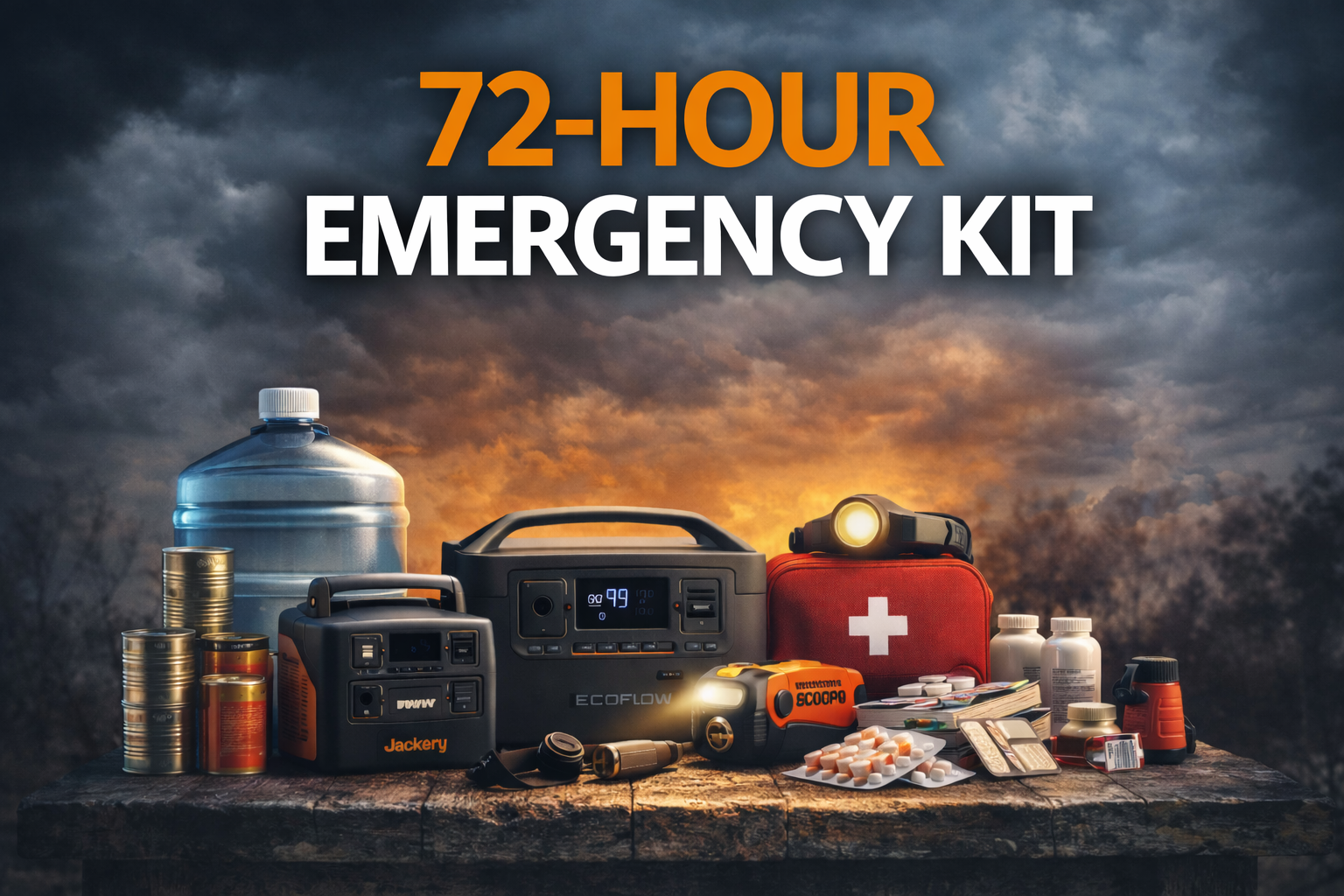
72-Hour Emergency Kit Gear Hub (US + Canada)
This 72-hour emergency kit gear hub makes it easy to finish your kit in the right order. Use the US links if you shop on Amazon.com, and the Canada links if you shop on Amazon.ca. Availability changes quickly during storms — that’s why this hub uses “Check price” category links.
Disclosure: As an Amazon Associate, SurvivalTactix earns from qualifying purchases. Some links may also be affiliate links (EcoFlow, Jackery, Survival Frog). This supports the site at no extra cost to you.
Jump to: Water • Power & Light • Food • Medical + Hygiene • Trusted Resources • FAQ
💧 Water (Priority #1)
Plan for 1 gallon per person per day for at least 3 days (more in heat, with kids, or if you’re active). Start with water storage, then add purification as your backup layer.
| Water item | US | Canada |
|---|---|---|
| Water storage containers (5–7 gallon, BPA-free) | Check price | Check price |
| Water purification tablets | Check price | Check price |
| Gravity water filter system | Check price | Check price |
| Water purification gear (Survival Frog — US) Alternative retailer for curated water purification gear. |
Check price | US only |
🔦 Power + Light
Your goals in an outage are simple: light, charged phones, and reliable updates. A strong baseline is headlamp + power bank + emergency radio. Upgrade to a power station if you need multi-day backup power.
| Power & light item | US | Canada |
|---|---|---|
| Power bank (20,000mAh+) | Check price | Check price |
| Headlamp + batteries | Check price | Check price |
| Emergency radio (hand-crank / weather alerts) | Check price | Check price |
| Emergency radios (Survival Frog — US) Alternative retailer for curated emergency radios. |
Check price | US only |
| Portable power stations (US only) For multi-day backup power. Choose based on what you must run. |
Check price (EcoFlow — US) Check price (Jackery — US) |
US only |
🥫 Food (No-Cook)
For the first 72 hours, keep food simple: ready-to-eat calories you can eat cold, plus a manual can opener. If you have kids, add familiar snacks — it reduces stress and keeps morale steady.
| Food item | US | Canada |
|---|---|---|
| Emergency food bars (ready-to-eat) | Check price | Check price |
| Ready-to-eat meals (MRE-style) | Check price | Check price |
| Manual can opener | Check price | Check price |
| Emergency food kits (Survival Frog — US) Alternative retailer for curated emergency food kits. |
Check price | US only |
🩹 Medical + Hygiene
Small injuries and poor air quality can become big problems during cleanup. Cover the basics: a practical first aid kit, masks for smoke/dust, and gloves for debris. If anyone takes prescriptions, keep a buffer supply when possible and maintain a simple med list (name/dose).
| Medical item | US | Canada |
|---|---|---|
| Comprehensive first aid kit | Check price | Check price |
| N95 masks | Check price | Check price |
| Nitrile gloves | Check price | Check price |
| First aid supplies (Survival Frog — US) Alternative retailer for curated first aid supplies. |
Check price | US only |
📚 Trusted Resources (Non-Affiliate)
Related guide: Long-Term Food Storage for Emergencies (Ultimate Blueprint)
Calm + Courage: Preparedness can feel heavy — especially when life is already full. You don’t need to do everything today. Pick one small win: add a little extra water, test your flashlights, or write down your family’s meetup plan. Small steps compound fast, and future-you will be grateful you started.
❓ FAQ
How much water do I need for 72 hours?
A practical baseline is 1 gallon per person per day (drinking + basic hygiene). If you can store more, do it — especially during hot weather or for larger households.
I live in an apartment — what should I buy first?
Start with water storage, then headlamp, power bank, and an emergency radio. Those four items solve the biggest problems in most urban outages.
How do I choose a portable power station?
Start with what you must run (phones/lights vs. fridge/CPAP). Compare capacity (Wh), output (W), and recharge options. Choose the smallest unit that reliably covers your must-run items.
What food is best for a 72-hour kit?
Choose no-cook, ready-to-eat calories you’ll actually eat under stress: food bars, shelf-stable meals, and familiar snacks. Keep a manual can opener if you store canned food.
How often should I review or replace items?
Every 6 months is a solid rhythm: test flashlights/radios, replace batteries, rotate food, and confirm medical supplies are in date.
© SurvivalTactix.com — Build your kit in layers. Water first. Light second. Food third. Medical always.