

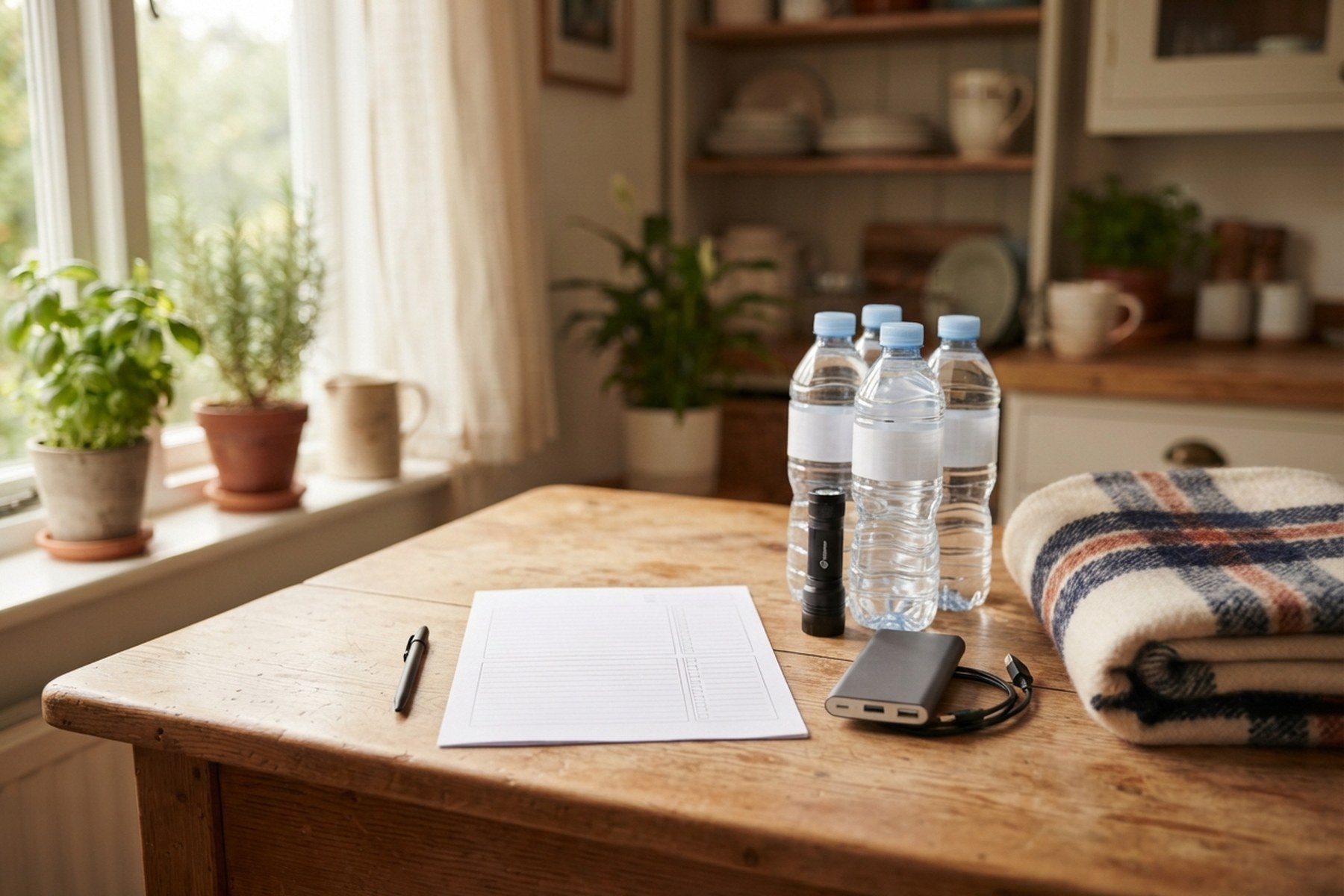
Quick Answer: The Household Readiness Plan turns a few answers about your home into a personal plan: litres of water, days of food, watt-hours for your devices, three actions for this week and a buy-first kit list. It calculates in your browser, saves nothing unless you ask for the link by email, and prints on one page for most households.
J.T. Wilder | Survival strategist, Survival Tactix | Last updated: October 24, 2026
Most emergency checklists give everyone the same numbers. A single person in a studio apartment and a family of six in a house with a well do not need the same plan, and a household that runs a CPAP machine overnight needs one more line than most. This page asks for the facts that change the answer, does the arithmetic where you can see it, and quotes the official source for each government rule it uses. Where a line is our own advice, the page says so.
Jump to: Build your plan • How the numbers work • What it leaves out • FAQ • Sources
Disclosure: This plan is free. The kit list it builds carries affiliate links, marked Our pick, and SurvivalTactix earns from qualifying purchases as an Amazon Associate. The links never change your numbers.
How do I build my household plan?
Email me the link to my plan
We will email you a link that rebuilds this plan. The link holds the answers you gave, so we keep it with your email address. It is free and you can unsubscribe from any email.
How are the numbers calculated?
Water is people multiplied by the daily amount multiplied by the days you plan for, rounded up to the next litre. Canada’s emergency kit page says to plan on about four litres per person per day, and Ready.gov says one gallon per person per day for drinking and sanitation. The plan uses the figure for your country and shows it on screen.
Children, infants and seniors each count as one person. Ready.gov says children, nursing mothers and sick people may need more water, and that in very hot temperatures water needs can double. Neither source gives a number for each person, so the plan does not invent one: add water to the total if anyone needs more or the weather is hot.
Food is shown as person-days of non-perishable food, because the official kit pages ask for a several day supply and give no calorie figure. The plan does not print a calorie number. Choosing food that needs no cooking and no water for the first day is our advice, not a rule from those pages.
Device energy is watts multiplied by the hours you run the device each day, shown for one, three and seven days. You type the watts from the device label, because a made-up default would be wrong for your machine. The result is an estimate and the plan says so.
The three actions come from a fixed order: carbon monoxide alarm first when you burn fuel or plan to run a generator, then backup for a medical device, then water, radio, an out-of-area contact, shutoffs and a sump pump backup. The plan shows the first three that apply to you. The minutes beside each action are our own estimate.
What does the plan leave out on purpose?
It does not rate your neighbourhood for floods, storms or earthquakes, and it does not list local alert pages. We could not find an official regional rating we were able to read, and we have not verified local alert pages for every area, so the plan shows the rules that follow from your own answers and the month, and sends you to your municipality’s hazard list and alert sign-up.
It does not size a power station for you, because usable capacity differs by model. It tells you what to check on the spec sheet. It does not tell you which medical backup to buy: that is for your prescriber or equipment supplier, and a power station should not stand in for the backup plan for oxygen or dialysis equipment.
Building a plan stores nothing on our side. Your plan link is a web address that holds your answers, and anyone who has the link can see them, so share it only with people you trust. If you ask us to email you the link, we keep it with your email address.
Calm + Courage: A plan on paper is worth more than a perfect plan in your head. Finish the three actions this week, then print the page and put it where everyone can find it.
What else do people ask about the plan?
Is the Household Readiness Plan free?
Yes. The plan and the printable page are free and you do not need to give an email address to see them. If you use the email form, it sends you a link back to your plan and then occasional preparedness emails, and you can unsubscribe in any email.
What happens to my answers?
The plan is calculated in your browser and nothing is sent when you build it. If you ask us to email the link, we keep your email address and the plan link, which holds your answers (household size, devices and the watts and hours you typed). The postal or ZIP code you type is cut to its first three characters in your browser. Our site analytics record page addresses, so a plan link you open is recorded like any other page address.
Does it work for both Canada and the United States?
Yes. A Canadian postal code starts the Canadian water figure and sources, and a US ZIP code starts the Ready.gov figure and sources. The plan does not list local alert pages. It tells you to check your municipality’s hazard list and alert sign-up.
How many days should I plan for?
Government of Canada guidance asks households to be ready to look after themselves for at least 72 hours. The plan suggests seven days from November to March in Canada and three days otherwise, and you can pick three or seven yourself.
Can I use the plan for medical devices?
It adds up the watt-hours of the devices you name, from the watts you type. It is not medical advice. Ask the prescriber or the equipment supplier what backup they recommend for your equipment, and do not rely on a power station for oxygen or dialysis equipment unless they say it suits that device.
Can I print it?
Yes. The print button gives you a compact layout for Letter or A4 paper with the household summary, the numbers, your actions, the safety lines, the kit list and lines to fill in by hand. It fits one page for most households, and a very large one may run to a second page.
Where do the numbers and rules come from?
Official sources
- Government of Canada, Get prepared: emergency kits
- Government of Canada, Power outages: how to prepare
- Public Safety Canada, Natural hazards
- Health Canada, Carbon monoxide: preventing exposure
- Ready.gov, Build a kit
- Ready.gov, Water
- Ready.gov, Winter ready
- Ready.gov, Power outage hazard info sheet
Related SurvivalTactix guides
Next step: finish your three actions this week
Then read the guide that matches your biggest gap.