Back-to-School Family Emergency Plan: Pickup Failures, Home-Alone Readiness, and School Lockdowns
J.T. Wilder | Survival strategist, Survival Tactix | Last updated: August 20, 2026
Disclosure: As an Amazon Associate, we earn from qualifying purchases. Some links on this page are also affiliate links through AWIN. This supports the site at no extra cost to you.
Quick Answer: Your Back to School Family Emergency Plan
This back to school family emergency plan starts with one step: build a written pickup-failure plan and a backpack emergency card today. Confirm two backup pickup adults, teach your child your out-of-area contact by heart, and learn your school’s reunification process. That combination prevents most of the panic when a pickup mix-up, a lockdown, or an unplanned after-school gap catches your family off guard.
Jump to:
Pickup-Failure Plan · Backpack Emergency Card · Home-Alone Readiness · After-School Emergency Kit · Lockdowns & Reunification · Family Communication Plan · Common Mistakes · FAQ
Back-to-school season means your family’s daily routine runs through a building you don’t control, on a schedule you don’t set, with people you may never meet. Most days that’s fine. This back to school family emergency plan is for the days it isn’t: the missed pickup, the early dismissal nobody saw coming, the lockdown drill that turns out to be real. None of this requires fear. It requires five documents, one conversation with your kids, and about ninety minutes this week.
Every family’s preparedness plan should sit inside a broader household emergency plan: see our guide to being prepared for emergencies for the full picture beyond the school day.
What happens if you can’t pick up your child from school?
Every school has a released-to-whom policy, and most enforce it strictly: which is good, until you’re the parent stuck in traffic with no way to get there by the bell. Build your pickup-failure plan around three layers:
- Two backup adults on file, in writing. Call the front office and confirm your emergency pickup list is current: not just who you think is listed, but who’s actually in the system. Add a friend or neighbor, not only relatives, since relatives are often the ones traveling when you need a backup.
- A standing rule your child can recite. “If Mom or Dad isn’t here by [time], I go back to the front office and wait: I don’t leave with anyone not on the list, even if they say it’s an emergency.” Practice this like a fire drill, not a one-time conversation.
- A same-day notification habit. Text the office (not just the teacher) the moment you know you’ll be late or need to swap pickup adults. Most delays turn into non-events specifically because the school knew in advance.
Quick Pick: A dedicated kids’ GPS watch removes most of the anxiety in this scenario, since your child can reach you (and you can see where they are) without needing a smartphone. Gabb Watch 3e: Check price (US) · Check price (Canada)
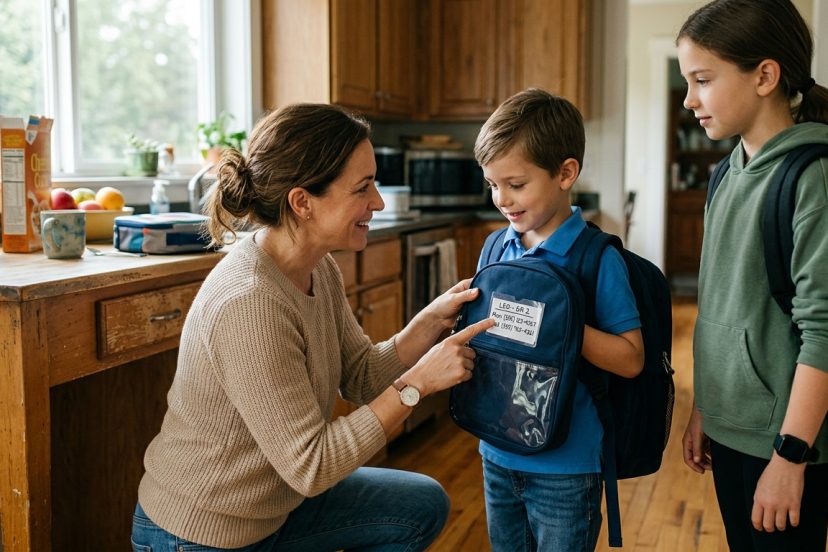
What should go on your child’s backpack emergency card?
The CDC recommends a simple, low-tech backup that works even when phones die or networks jam: an index card in the backpack. Their exact guidance is to “put an emergency card in your child’s backpack” so that emergency contact information, medications, and allergies are “readily available” to any adult who needs them: a teacher, a school nurse, or a first responder who has never met your child.
Your card should include:
- Two emergency contacts with phone numbers (not just one: the CDC’s own point is redundancy)
- Any medications, dosages, and allergies, including severity (mild reaction vs. anaphylaxis)
- Your child’s full name, birthdate, and any relevant medical conditions (asthma, diabetes, seizure disorder)
- A pediatrician’s name and phone number
- Your family’s out-of-area contact (see the communication plan below)
Laminate it if you can, since backpacks are hard on paper. Update it every school year: allergies and medications change faster than most families remember to update the card.
Quick Pick: HoHpHq Emergency Contact Card 12-Pack: Check price (US) · Check price (Canada) (exact 12-pack ASIN not confirmed available in Canada: flagged for review)
Is my child ready to stay home alone after school?
There’s no single legal age in most of the US or Canada, and the American Academy of Pediatrics is intentionally cautious here: their guidance is that around 11 or 12 is “an appropriate age to stay home alone for a few hours,” while noting this varies by child and by family. Readiness is about judgment, not just birthdays.
Home-alone readiness by age band
| Age | Typical readiness | What to verify first |
|---|---|---|
| Under 8 | Not developmentally ready for unsupervised time, per AAP guidance | Arrange supervised after-school care |
| 8–10 | Very short stretches only (a few minutes, not hours), with clear rules | Can they follow a simple rule under stress? Do they panic or freeze? |
| 11–12 | AAP’s general starting point for a few unsupervised hours | Do they know emergency numbers by memory, not just by phone? |
| 13+ | Most teens can handle regular after-school time alone | Do they still check in on schedule, and know when to call 911 vs. you? |
Before extending independence, the AAP recommends evaluating maturity and judgment (can they think before acting, resist pressure from peers who show up unannounced), comfort and safety awareness (do they know the emergency plan, not just live near it), and practical skills (can they occupy themselves without screens, recall key phone numbers, and use appliances safely). Run at least one test scenario, a short supervised trial where you’re reachable but not present, before trusting a longer stretch alone.
Quick Picks: A door/window sensor gives you a phone alert the moment an entry point opens, which matters more for home-alone kids than any camera. WiFi Door/Window Sensor 4-Pack: Check price (US) · Check price (Canada)
A kid-safe phone with GPS and call/text only (no open internet or social apps) is the simplest way to stay reachable without handing a young teen a full smartphone. (The Gabb Phone 4’s Amazon listing is currently unavailable; the Gabb Watch 3e in this guide covers the same need for younger kids.)
Home-alone readiness is not just about physical safety. If your child uses a phone, tablet, or gaming account while home alone, it is worth locking down the digital side too, so see our Family Digital Security guide for the one setting to change on a kid’s account tonight.
What should be in an after-school emergency kit?
This isn’t a full 72-hour bag: it’s a small, boring kit that solves the ordinary problems of an unsupervised hour: a power outage, a small cut, a dead phone.
- A flashlight that also charges a phone, kept somewhere the child actually knows to find in the dark
- A compact first aid kit, stocked and checked twice a year
- A backup phone charger or battery pack
- A printed list of emergency numbers taped inside a kitchen cabinet: batteries die, paper doesn’t
- A simple snack and water, in case “come straight home” turns into “shelter in place for an hour”
Quick Picks: PowerSmith Flashlight + Power Bank: Check price (US) · Check price (Canada) · Compact First Aid Kit (228-piece): Check price (US) · Canada: Pac-Kit Watertight Explorer 2 (110-piece comparable kit) (the exact 228-piece kit is not confirmed available in Canada, so this is a comparable compact, watertight kit sold there)
For the fuller home version of this kit, see our 72-Hour Emergency Kit Gear Hub.
How do schools handle lockdowns and reunification?
Most US school districts, and a growing number of Canadian ones, now train staff and students on the “I Love U Guys” Foundation’s Standard Response Protocol (SRP) and Standard Reunification Method (SRM). These aren’t a single district’s invention; the Foundation’s programs are now used in more than 78,000 schools, districts, agencies, and organizations. If your school uses this framework, your child will already know the five SRP actions (Hold, Secure, Lockdown, Evacuate, Shelter) from drills, even if you’ve never heard the terms.
What matters for parents is the reunification side, which is where families lose the most time and composure:
- Know your school’s official reunification location before you ever need it: it’s often not the main entrance, and can be a nearby church, gym, or park.
- Expect ID verification. Under SRM, you won’t get your child released just by asking or by being recognized; you’ll typically need photo ID and to be on the approved pickup list already discussed above.
- Don’t drive to the school itself during an active incident. Reunification sites are chosen specifically to keep the school’s immediate area clear for first responders. Going to the wrong location, or to the school directly, slows down your own reunification.
- Ask your school (in a calm season, not a crisis) whether they use SRP/SRM, and if so, where the reunification site is. Most schools will tell you; if yours won’t or doesn’t know, that’s worth raising at the next parent meeting.
How do we build a family communication plan?
Ready.gov’s Family Communication Plan exists because local calls are often the first thing to fail in a real emergency: cell towers overload faster than long-distance routing does. Their fillable planning card (free download at ready.gov) asks every family to set up:
- An out-of-area contact: someone outside your immediate region who each family member calls or texts if local lines are jammed. Everyone, including kids, should know this number by memory.
- A meeting place near home and a second meeting place outside the neighborhood, in case you can’t get home at all.
- Each family member’s school/work address and main phone numbers, written down: not just saved in a phone that might be dead or left behind.
- A workplace and school emergency plan check: ask your child’s school directly what their own communication plan is during a lockdown or evacuation, since assuming it matches your own plan is one of the most common mistakes below.
Communication and navigation redundancy matters beyond just family contact: see why communication and navigation are critical for survival and emergencies for the broader picture.
Quick Pick: A pair of two-way radios is the low-tech backup when cell networks are the problem, not the phones themselves. Motorola Talkabout T470 (4-Pack): Check price (US) · Check price (Canada): 2-pack (Canadian listing is a 2-pack, not the US 4-pack: pack sizes differ, flagged for review)
What mistakes do parents make with back-to-school emergency planning?
- Assuming the school’s plan matches yours. Ask directly what protocol they use and where reunification happens: don’t guess.
- Listing only relatives as backup pickups. Relatives travel too. Add at least one local friend or neighbor.
- Never testing the plan. A rule your child has heard once isn’t a rule they’ll follow under stress. Practice it like you would a fire drill.
- Treating the backpack card as a one-time task. Allergies, medications, and contacts change. Review it every August, not just the first year.
- Overbuilding the after-school kit. This isn’t a bunker: a flashlight, a charged way to communicate, and a first aid kit cover the realistic scenarios. Don’t let the list balloon until nobody maintains it.
A small step is still a step
Preparedness is built in small steps, not perfect leaps. Pick one small win today: confirm your pickup list, write the backpack card, or just have the "if I’m not there by X" conversation, and you’ll be more ready than you were yesterday. Keep going.
FAQ
What’s the single most important thing to do before the first day of school?
Confirm your emergency pickup list with the front office and make sure it includes at least one non-relative backup: this is the fastest fix in any back to school family emergency plan for the most common failure point.
What age can a child legally stay home alone?
Most US states and Canadian provinces don’t set a hard legal age; the AAP suggests 11–12 as a general starting point for a few unsupervised hours, based on the individual child’s judgment and readiness, not age alone.
What is the Standard Reunification Method?
It’s a nationally used framework (from the “I Love U Guys” Foundation, used in 78,000+ schools and organizations) for safely reuniting students with verified guardians after a lockdown or evacuation, typically at a designated site away from the school building itself.
Do I need a family communication plan if we all have smartphones?
Yes. Local cell networks are often the first thing to overload in a real emergency, even when phones themselves are fine. An out-of-area contact and a written plan don’t depend on local service working.
What goes in a backpack emergency card?
Two emergency contacts, medications and allergies with severity noted, your child’s name and birthdate, a pediatrician’s contact, and your family’s out-of-area contact: per CDC guidance on backpack emergency cards.
Recommended Gear Row
| Item | Best for | US | Canada |
|---|---|---|---|
| Gabb Watch 3e | Youngest kids, GPS + calls only | Check price | Check price |
| Motorola Talkabout T470 | Family two-way backup when cell networks jam | Check price (4-pack) | Check price (2-pack) |
| Survival Frog Bug-Out Bags | Full family go-bag to pair with this plan | Shop collection | US only: Survival Frog ships only within the USA, not to Canada |
Disclosure reminder: We only recommend gear we’d use ourselves as part of this back to school family emergency plan. As an Amazon Associate and AWIN affiliate, we earn from qualifying purchases at no extra cost to you.
Sources
- CDC: Children & School Preparedness: Before, During, and After an Emergency
- HealthyChildren.org (American Academy of Pediatrics): Is Your Child Ready to Stay Home Alone?
- The “I Love U Guys” Foundation: Standard Response Protocol & Standard Reunification Method
- Ready.gov: Family Communication Plan