Stranded Overnight at the Airport: What to Carry and What to Do
Fast track
Short on time? Go straight to the five things to carry, or to what to do in the first 30 minutes after a cancellation.
Quick Answer: Keep five things in your carry-on: a power bank with its cable and wall charger, a paper card with the numbers that matter, medicines in their labelled containers, an empty water bottle and a snack, and a few small bills. If a flight is cancelled, ask what the airline covers and keep your receipts.
J.T. Wilder | Survival strategist, Survival Tactix | Last updated: November 15, 2026
Being stranded overnight at the airport rarely starts with a plan. It starts with an announcement, a long line at the service desk and a phone at 20 percent. A cancelled flight is an ordinary disruption, and a traveler can be ready for it with a few small things that already fit in a carry-on.
This guide covers what to carry, what the FAA and, in Canada, the Canadian Air Transport Security Authority (CATSA) say about power banks, what to do in the first 30 minutes after a cancellation, and what you may be owed. Nothing here needs special gear. It is the same calm preparation as our other 72-hour guides, scaled down to one night. For the household version, start with the free Household Readiness Plan.
Flying for Thanksgiving or the winter holidays? Everything below applies, and a few items matter more. When the flights around yours are full, a cancellation leaves fewer open seats to rebook onto, so a long wait is more likely. Arrive with all five carry-on items packed, including a charged power bank and your paper card, and you are ready for a long line instead of a surprise.
Jump to: What to carry • Power bank rules • First 30 minutes • Refunds • Getting through the night • FAQ
Disclosure: This article contains affiliate links. If you buy through them, Survival Tactix may earn a commission at no extra cost to you. As an Amazon Associate, we earn from qualifying purchases. We have not tested these products. Read the listing and check the price the day you buy.
Last checked: November 13, 2026, when we read the FAA, TSA, Department of Transportation and Canadian Transportation Agency pages named in the sources below, and again on November 14, 2026 for the FAA lithium batteries page, the TSA medication and liquids pages, the TSA extension cord page and the two U.S. Department of Transportation pages. On November 14, 2026 we also read the CATSA guidelines for batteries and the Ready.gov Get Tech Ready page. On November 15, 2026 we read the TSA medication FAQ, the TSA What Can I Bring medications page and the U.S. Department of Transportation refunds page again and made the wording of several sentences match them. On November 15, 2026 we also read the Canadian Transportation Agency page again and made the wording of its conditions match it. The two product notes repeat what we read on their store pages on November 10, 2026. We did not re-read the store pages for this guide, and no prices are shown.
What should you carry in case you are stranded overnight at the airport?
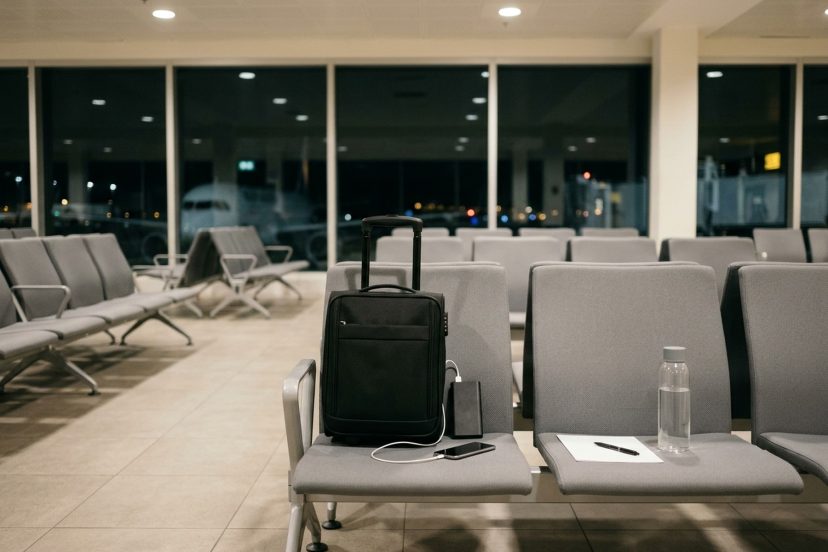
Five ordinary items cover most of a night you did not plan. None of them is a survival tool. Each one keeps a phone alive, keeps your information readable, or keeps you fed, watered and medicated until the next flight.
At a glance: five things for a night you did not plan
| Carry | Why it earns its place | What to check |
|---|---|---|
| A power bank, its cable and a wall charger | A dead phone cannot show a boarding pass, rebook a flight or call home. | The FAA says spare lithium batteries and power banks go in your carry-on, so never your checked bag. The rules are below. |
| A paper card | Phone numbers and booking details stay readable when a phone is not. | Write the out-of-area contact, the airline’s phone number, your booking reference and any medical needs. Update it when a number changes and each time you book a trip. |
| Medicines in their labelled containers | A delay can run past a dose time, and your checked bag may be out of reach. | TSA’s medication FAQ says you may bring medically necessary liquids, medications and creams in excess of 3.4 ounces or 100 milliliters in your carry-on bag. It has you remove them from the bag to be screened separately and recommends clear labels. TSA’s What Can I Bring page adds that it allows these in reasonable quantities for your trip and that you must declare them to TSA officers at the checkpoint. |
| An empty water bottle and a snack | A long wait is easier with water and food in reach. | TSA limits liquids to containers of 3.4 ounces (100 milliliters) or less per item, so pack the bottle empty and fill it after security. |
| A few small bills | They cover a vending machine or a ride if a card will not. | Our cash guide covers how much to keep and which bills to choose. |
The paper card is the same idea as the one in our family communication plan, shortened to a single night. How much extra medicine to pack for a delay is a question for your doctor or pharmacist, not for a travel guide.
What do the FAA battery rules mean for your power bank?
The power bank is the one item on the list with a rule attached. The FAA’s PackSafe page says spare lithium batteries, which include power banks, must be carried in carry-on baggage only, so never in a checked bag. If a carry-on is checked at the gate, the page says all spare lithium batteries and power banks must be removed from the bag and kept with you in the cabin.
Size matters too. The FAA limits lithium ion batteries to 100 watt-hours (Wh) per battery. With airline approval, a passenger may also carry up to two spare larger batteries of 101 to 160 Wh. To find the watt-hours, the FAA says to multiply the battery voltage by the amp-hours (Ah). A battery rated 20 Ah at 3.7 volts, for example, works out to 74 Wh. Many power banks print their watt-hours on the label, so read yours before you travel, and keep the terminals protected from a short circuit, for instance with tape or a battery case, as the FAA describes.
Airlines can be stricter. The FAA page notes that many airlines, domestic and international, may have stricter quantity and watt-hour limits, so check your own airline’s rules. Then charge the power bank to full the night before every trip, using its own cable and a wall charger, so it is full when a delay starts.
In Canada, CATSA’s guidelines for batteries tell travelers to keep all batteries and electronic devices containing batteries on them or packed in their carry-on baggage. CATSA says most airlines follow International Air Transport Association guidelines, which typically allow power banks up to 100 Wh without special approval and those between 100 Wh and 160 Wh with airline approval, and its table lists a maximum of two individually protected spare batteries of 101 to 160 Wh per person in carry-on, with air carrier approval. It also notes that several airlines have policies on carrying and using lithium batteries on board, and that many airlines prohibit charging devices onboard. Check your airline’s policy before you count on using a power bank in the air.
Anker Prime Power Bank, 20,100 mAh
The listing describes a 220W maximum output, three ports and two-way charging. That is laptop-class output, so it suits a traveler who charges a laptop as well as a phone. Read the watt-hours printed on the unit you buy against the FAA’s 100 Wh limit before you fly.
What about a home power station? The FAA’s power-station poster says lithium battery-powered devices of more than 160 Wh are not allowed on passenger aircraft. Check the watt-hour label before you pack one. Our EcoFlow versus Jackery guide covers using one at home during an outage.
What should you do in the first 30 minutes after a cancellation?
Speed helps, but order helps more. Work through these in turn:
- Find an outlet and plug in. Everything that follows runs on your phone, so charge it before you queue.
- Open your airline’s app or website while you head to the service desk. The Department of Transportation (DOT) says airlines often offer to rebook passengers on other flights after a cancellation or significant delay or change, though it does not require them to, so the app may show options and you can ask for one by name. Try more than one route at once: the airline’s phone line or chat, and a self-service rebooking kiosk if you see one. If you are traveling with someone, one of you can hold your place in line while the other works the phone.
- Write down what you are told. Note the new flight, who gave it to you and the time, on your paper card.
- Ask what the airline will cover. The DOT says you may be entitled to compensation for certain expenses and/or amenities if a delay was due to something in the airline’s control and causes a long enough inconvenience during travel. For cancellations and delays within the airline’s control, it points travelers to the airline’s customer service plan. The DOT’s airline cancellation and delay dashboard lists the commitments airlines make when they cause a cancellation or significant delay.
- Send one message home. Give your flight, where you are and when you will update, using the out-of-area contact on your card. One message at an agreed time uses less battery than a stream of replies. To reach home, text rather than call. Ready.gov says mobile networks can become overwhelmed during emergencies, which makes calls hard to make and get, and that text messages require less bandwidth, so they can be transmitted more reliably when many people are trying to use their phones at the same time.
- Keep every receipt. Meals, rides and rooms add up, and you will want the receipts if you claim anything back. If you paid for the trip with a credit card, check whether the card’s own terms include trip-delay cover. What it pays, and when, depends on those terms, so read them before you count on it.
Are you owed a refund if the airline cancels your flight?
In the United States, the DOT says a consumer is entitled to a refund if the airline cancelled a flight, regardless of the reason, when the consumer chooses not to travel or accept travel credits, vouchers or other compensation offered by the airline. The refund goes back to the original form of payment, and for a credit card purchase the DOT says the airline must issue it within 7 business days after you reject the airline’s offer of another flight or other alternative. The DOT also says that if you bought your ticket directly from the airline and you do not accept the alternatives it offers, the refund must be issued automatically, without a request.
The part that matters is that the choice is yours. A voucher or credit is an alternative, and you can choose not to accept it.
In Canada, the Canadian Transportation Agency’s page on flight delays and cancellations says the airline must always make sure you can complete your itinerary as soon as possible. It also describes help the airline can owe you, including food and drink in reasonable quantities and, when you have to wait overnight, a hotel or other accommodation with transportation. The page ties that help to conditions: the delay or cancellation must be within the airline’s control (or within its control but required for safety), you must have been told less than 12 hours before your original departure time, and you must have waited at the airport 2 hours or more after that time. Read the page for the exact conditions that apply to your flight.
A refund covers the ticket, not the night. What the airline pays toward a meal, a ride or a room depends on the airline, its plan and why the flight was cancelled, so ask, and keep the receipts.
A two-pocket document bag
The listings describe a two-pocket bag, 15 by 11 inches. It keeps your boarding passes, booking confirmations, receipts and the paper card in one place, so a claim later takes minutes, not an afternoon.
How do you get through the night if you have to stay?
Once the logistics are done, the goal is simple: get through the wait comfortably and keep your options open. A few habits help.
- Stay near an outlet. Sit near a working outlet, and near the service desk if updates are given there. A short extension cord in your carry-on helps when the only free socket sits behind a row of seats, and it lets you share one socket with the person next to you, if they agree. Keep the cord out of walkways so nobody trips. TSA’s item page lists extension cords as allowed in carry-on bags, though the final decision rests with the TSA officer at the checkpoint. Your power bank covers the times you cannot stay at the wall, such as the line at the rebooking desk.
- Make the battery last. Switch the phone to low power mode while you wait; Ready.gov lists low power mode as a way to conserve energy. A long charging cable lets you sit comfortably while the phone charges from a wall outlet, and your own wall charger and cable mean you are not waiting your turn at a charging station.
- Keep your boarding pass and booking details without a signal. Take a screenshot of your boarding pass and booking confirmation so you can open them without a signal or the airline’s app. A screenshot may not scan at every gate, so also keep the booking reference on your paper card for the times the phone is dead.
- Keep the essentials on you. Phone, power bank, passport, wallet and medicines stay in a pocket or in a bag you keep within reach, not in one you set down and walk away from.
- Eat and drink. Fill your bottle once you are through security and eat the snack. Waiting is easier when you have had both. Terminal shops and restaurants may close for the night, so buy extra food and water while they are open.
- Pack for a night, not just a delay. A spare layer or scarf helps if the terminal turns cold, earplugs and an eye mask help you rest, and a clean change of clothes and toiletries are easiest to reach in your carry-on, since your checked bag may be out of reach. TSA limits liquids to containers of 3.4 ounces (100 milliliters) or less per item, so pack small sizes of any liquid toiletries. If you doze, loop a bag strap around your leg or arm so the bag stays with you.
- Set a phone alarm for each dose time you have. A dose time is easy to lose track of in the middle of the night. Ask your doctor or pharmacist what to do if a delay runs past one.
- Ask staff what to expect. Whether a terminal stays open overnight, and where passengers wait, varies by airport, so ask airline staff rather than assume.
- Agree a check-in time at home. One message at a set time keeps your battery for the morning. Our family communication plan covers how to pick the out-of-area contact.
To make this a habit, keep the five items in one pouch in your carry-on, so a trip never starts without them. Our 72-hour emergency checklist guide and gear hub cover the home side of the same idea.
Calm + Courage: One night away from your plan is something a prepared traveler gets through. You do not need to pack for every possibility. A charged phone, a paper card, your medicines, some water and a little cash are enough to turn a bad evening into a manageable one.
Frequently asked questions
Can I bring a power bank in my carry-on?
Yes. The FAA says spare lithium batteries, including power banks, must be carried in carry-on baggage only. Each lithium ion battery is limited to 100 watt-hours, and with airline approval you may carry up to two larger spare batteries of 101 to 160 watt-hours. Many airlines may have stricter limits, so check yours. In Canada, CATSA says to keep all batteries and electronic devices containing batteries on you or in your carry-on, and its battery table lists a maximum of two individually protected spare batteries of 101 to 160 watt-hours per person in carry-on, with air carrier approval.
Can I fly with a portable power station?
The FAA’s power-station poster says lithium battery-powered devices of more than 160 Wh are not allowed on passenger aircraft. Check the watt-hour label before you pack one.
Do I get a refund if my airline cancels my flight?
In the United States, the DOT says you are entitled to a refund if the airline cancelled the flight, regardless of the reason, when you choose not to travel or accept travel credits, vouchers or other compensation offered by the airline. For a credit card purchase, the DOT says the airline must issue the refund within 7 business days after you reject its offer of an alternative.
Can I carry medicine in my carry-on bag?
Yes. TSA’s medication FAQ says you may bring medically necessary liquids, medications and creams in excess of 3.4 ounces or 100 milliliters in your carry-on bag. It has you remove them from the bag to be screened separately and recommends clear labels to help screening. TSA’s What Can I Bring page adds that it allows these in reasonable quantities for your trip and that you must declare them to TSA officers at the checkpoint. Ask your doctor or pharmacist how much extra to pack for a delay.
Will the airline pay for a hotel?
It depends on the airline, its customer service plan and why the flight was cancelled. The DOT says you may be entitled to compensation for certain expenses and/or amenities if a delay was due to something in the airline’s control and causes a long enough inconvenience during travel. For cancellations and delays within the airline’s control, it points you to the airline’s plan. In Canada, the Canadian Transportation Agency describes a hotel or other accommodation, with transportation, when the delay or cancellation requires you to wait overnight, and only where it was within the airline’s control (or within its control but required for safety), you were told less than 12 hours before your original departure time and you waited at the airport 2 hours or more after that time. Ask, and keep your receipts.
Sources and related guides
Trusted external resources
- FAA PackSafe: Lithium batteries
- FAA PackSafe: Power stations poster (PDF)
- TSA: Traveling with medication
- TSA: What can I bring? Medications (liquid)
- TSA: What can I bring? Extension cord
- TSA: Liquids rule
- U.S. DOT: Refunds
- U.S. DOT: Airline cancellation and delay dashboard
- Canadian Transportation Agency: Flight delays and cancellations
- CATSA: Guidelines for batteries
- Ready.gov: Get Tech Ready
Related Survival Tactix guides
Next step
Pack the five items once, and the next delay is an inconvenience, not a scramble.