Emergency Preparedness Gifts for the Household That Would Rather Be Ready
J.T. Wilder | Survival strategist, Survival Tactix | Last updated: November 2, 2026
On this page: What makes a gift actually useful · Everyday carry picks · Staying warm and informed · Water and first aid · Protecting documents · Power stations as gifts · What to skip · Turning a gift into a plan · FAQ
Every year, someone on your list gets a flashlight that never leaves the junk drawer or a “72-hour survival kit” stuffed with gear nobody has ever tested. A good emergency preparedness gift does not look like a doomsday prop. It looks like something the person will actually reach for, whether that is during a three-hour outage after an ice storm or just when the power bank in their bag dies on a Tuesday. This guide sticks to gifts with a specific, honest job to do, priced from gift-card range up to the kind of thing a family splits between a few people.
Every pick below links a real product page, not a search result, in both the United States and Canada where the same or an equivalent model is sold. Nothing here is tested gear from our own hands on; where we have not used a product personally, we say so and point to the manufacturer’s own specifications instead of inventing a review.
What makes an emergency preparedness gift actually useful?
Three questions separate a gift that gets used from one that gets forgotten in a closet. Does it do a job the person already has, just better (charging a phone, lighting a hallway, carrying water)? Does it need no training to pick up and use correctly on the first try? And does it keep working without a subscription, an app login, or a battery chemistry prone to its own recalls? Ready.gov’s own basic disaster supplies list leans on exactly this kind of plain, dependable gear: water, a way to make more of it drinkable, light, a radio, and a way to charge a phone, rather than anything exotic.
That is also why this guide treats “gift” and “kit filler” as the same category. A real first aid kit someone will actually open is a better gift than a vacuum-sealed bucket of unlabeled supplies, and a headlamp someone will wear while bringing in groceries during a blackout is a better gift than one that only comes out once a year.
Which everyday carry gifts cover the most ground?
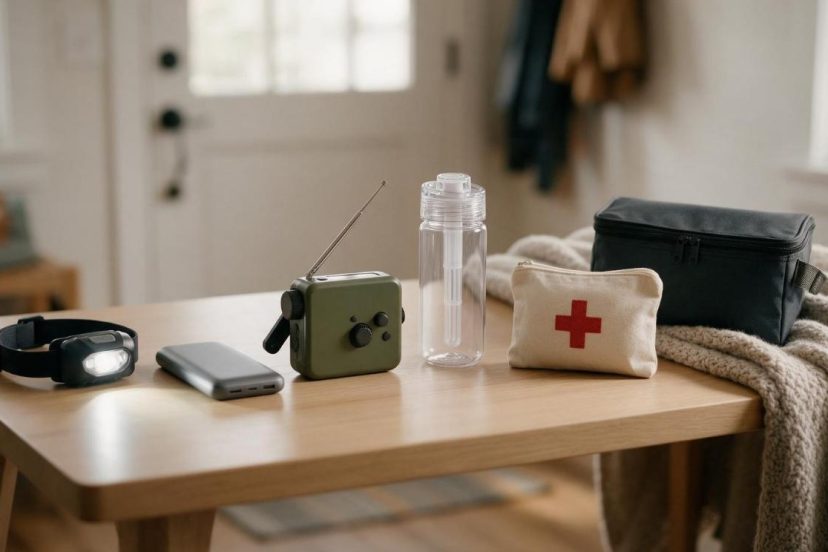
Two items do double duty every single day, not just during an outage: a power bank and a headlamp. Both are gifts people use constantly, so neither one has to wait for an emergency to earn its place.
A real power bank, not the free one from a conference
A phone is most people’s flashlight, map, and way to call for help, so keeping it charged is not optional. A power bank in the 20,000 mAh class can take most phones from empty to full several times over, and a model with pass-through charging lets someone top it up overnight without unplugging anything.
A headlamp beats a flashlight for anything hands-on
A headlamp leaves both hands free, which matters when someone is carrying a child, checking a breaker panel, or cooking on a camp stove in the dark. A rechargeable model with a simple on and off switch, no menu to learn, is the one that actually gets grabbed first.
What is worth getting for staying warm and informed?
When cell towers get overloaded or the power goes out for days instead of hours, a radio that does not need the grid and a way to warm cold hands both earn their place on a gift list.
A hand crank weather radio, for when the apps go quiet
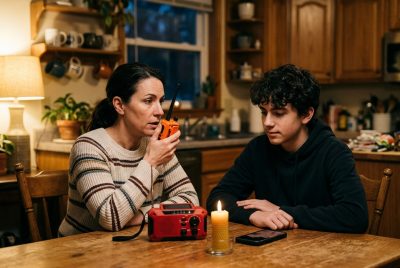
A radio that pulls NOAA weather alerts and runs on a hand crank, solar panel, or standard batteries keeps someone informed even when their phone’s battery and the cell network both give out. Ready.gov lists a battery or hand crank radio as one of the handful of items every household kit should contain.
Hand warmers: why disposable beats rechargeable right now
Rechargeable lithium hand warmers have been easy to find the last couple of winters, but two of the category’s larger brands have active fire recalls open right now. The U.S. Consumer Product Safety Commission’s recall of OCOOPA rechargeable hand warmers (about 1.5 million units, reported July 30, 2026) and its recall of Kobayashi’s HotHands-branded rechargeable warmer (model H163650, reported October 1, 2026) both cite overheating and fire risk, and Health Canada issued its own notice on the OCOOPA units on September 3, 2026. Neither notice says anything about the traditional, disposable, air-activated hand warmer pouch, which has no battery at all. That is the safer gift right now, and it costs less too.
What should you give for water and basic injuries?
Clean water and basic first aid are the two gifts that matter most in almost any disruption, from a boil-water advisory to a twisted ankle on a hike.
A personal water filter bottle, for the tap that might not be safe
A filter bottle that removes bacteria, parasites, and microplastics as the person drinks turns a questionable tap, a stream, or a boil-water advisory into a non-event. It is also genuinely useful for travel and everyday hiking, which is exactly the kind of year-round use that makes a preparedness gift worth giving.
A first aid kit that is actually stocked for a household
Most medicine cabinets have a box of bandages and not much else. A kit built for a household, not a single hiker, covers burns, sprains, and minor wounds without anyone needing to run to a pharmacy first. The US and Canadian picks below are different products sized for the same job; check the contents list against your own household before buying.
What about protecting important documents?
Passports, birth certificates, insurance policies, and property deeds are some of the hardest things to replace after a fire or a flood, and some of the easiest to protect ahead of time. A fireproof, water-resistant document bag is a gift that costs very little and solves a problem most households have never gotten around to fixing.
Pair the bag with our Offline Emergency Binder guide for what to actually print and store inside it, since a bag that only holds a spare phone charger is not doing its job.
Is a portable power station a good gift?
For someone who already has the basics above, a portable power station is the gift that moves them from “can get through a few hours” to “can keep a fridge, a CPAP, or a sump pump running for a day or more.” It is also the gift with the widest price range, so match the size to what the person actually needs to run rather than buying the biggest unit on the page.
Not sure which capacity actually covers what you need to run? Our solar generator buying guide and our EcoFlow vs. Jackery comparison walk through watt-hours and real device run times in plain terms.
What should you skip when buying preparedness gifts?
Three categories are easy to buy and easy to regret. First, unlabeled “bug out bag” bundles that list no actual contents; if a listing cannot tell you what is inside, assume it is padded with filler. Second, any rechargeable lithium hand warmer that has not individually cleared both the US CPSC and Health Canada recall lists by model number on the day you buy it, for the reasons above. Third, anything that needs a phone app, a subscription, or a proprietary charging cable to function at all, since that is one more point of failure during the exact situation the gift is meant for.
How do you turn a gift into a full household plan?
Any one of these gifts is useful on its own. All of them become much more useful once they are part of a plan the household has actually walked through: where the supplies are kept, who grabs what, and what the first hour after an outage or a storm warning actually looks like. Our free Household Readiness Plan builds that plan around your own household size, pets, and any medical devices in about five minutes, and tells you exactly which of the picks above still has a gap in your own kit.
For the household dealing with winter outages specifically, our blackout survival guide and our no-heat survival guide go deeper on what to do once the gift is unwrapped and the power actually goes out.
You do not need to buy everything on this list
Preparedness is not a single big purchase. It is a handful of ordinary, dependable things that someone actually knows how to use, picked up a little at a time. A headlamp this year, a water filter next year, a power station when the budget allows it. Giving one good, honest gift is a better gift than giving the appearance of being ready.
Frequently asked questions
What is the single best emergency preparedness gift under $30?
A rechargeable headlamp or a 40-pair pack of disposable hand warmers both land comfortably under $30 and get used constantly, not just during an emergency.
Are rechargeable hand warmers safe to give as a gift right now?
Only after checking the specific brand and model number against the current CPSC and Health Canada recall lists the day you buy. Two major brands, OCOOPA and Kobayashi’s HotHands-branded rechargeable warmer, have active fire recalls as of late 2026. A traditional disposable, air-activated warmer has no lithium cell and is not affected.
Do I need a power station if I already have a generator?
Not necessarily, but a power station runs silently and indoors, which a fuel generator cannot safely do, so many households keep both for different situations.
Is a water filter bottle enough, or do I also need stored water?
A filter bottle is for water you can find, not water you already have on hand. Most guidance, including Ready.gov’s, still recommends storing at least one gallon of water per person per day as a baseline, with the filter as a way to extend that supply.
What should go inside a fireproof document bag?
Passports, birth certificates, property deeds, insurance policies, and a printed contact list are the core items most households are missing. Our Offline Emergency Binder guide has the full checklist.
How do I know what size power station a specific gift recipient needs?
Add up the watt-hours of what they actually want to run (a mini fridge, a CPAP, a phone and a laptop) over the number of hours they want to run it, then compare that to the station’s rated capacity. Our solar generator buying guide walks through the math with real examples.
Should I buy items separately or look for a pre-made kit?
Buying the individual pieces above lets you choose quality in each category instead of accepting whatever filler a pre-made bundle includes, and it usually costs about the same or less.