How Many Watt-Hours Do You Need to Run a CPAP During a Power Outage?
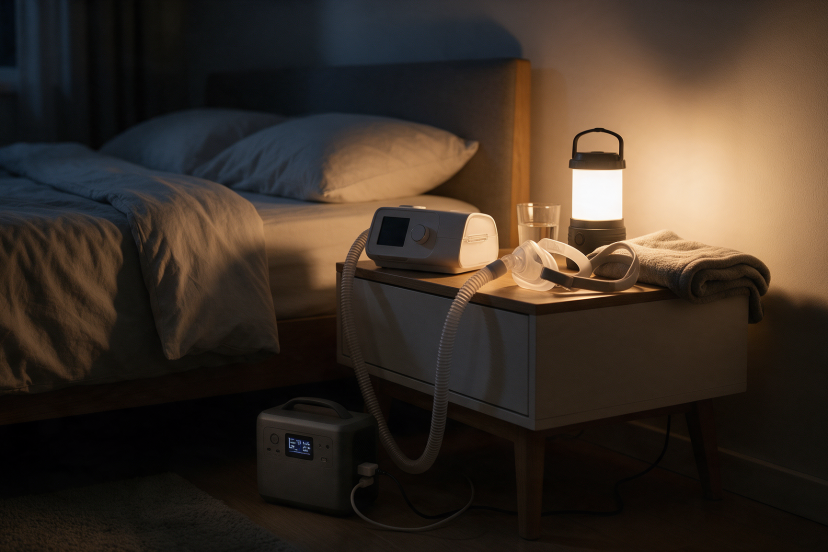
Fast track: the household-size pick
Most households sizing up for a CPAP with a heated humidifier land on a 1,000-watt-hour-class station. These are the two we point to most on the gear hub.
Quick Answer: A CPAP without a humidifier draws about 30 to 60 watts, roughly 240 to 480 watt-hours a night. With a heated humidifier, nameplate ratings run higher, though one 11-night test of a humidified machine measured 136 to 228 watt-hours a night. Check your machine’s label, then size your station to the higher figure.
J.T. Wilder | Survival strategist, Survival Tactix | Last updated: November 16, 2026
If you or someone in your house depends on a CPAP machine, a power outage is not an abstract inconvenience. It is a night with no therapy, which for a lot of people means a rough night at best and a real health risk at worst. The good news is that CPAP machines are genuinely low-power medical devices, and sizing a backup battery for one is a straightforward arithmetic problem once you know what number to plug in.
This guide walks through where the watt-hour number actually comes from, what independent testing found when someone measured a real machine overnight instead of trusting the sticker on the power brick, and how to translate that into a power station size you will not outgrow on the second night of an outage. We also cover the household readiness plan every anchor in this series points to, because sizing a battery is one line item in a bigger plan, not the whole plan.
Our EcoFlow versus Jackery comparison guide covers the two brands most households land on for a medical-device-capable power station in detail, with the full case for each. This guide focuses specifically on the number you need before you shop: how many watt-hours your CPAP actually needs to get through the night.
Disclosure: This article may contain affiliate links. If you buy through these links, Survival Tactix may earn a commission at no extra cost to you. We only recommend products that fit the preparedness scenario and reader need. This article is educational and is not medical advice; talk to your prescriber or durable medical equipment supplier about your own device and situation.
Before you shop, it is worth building the rest of your household plan at the same time. Our free Household Readiness Plan walks through water, power and medical-device needs together and hands you a shopping list sized to your own household, not a generic one.
At a Glance: Watt-Hours by Setup
| Setup | Typical draw | Watt-hours, 8-hour night | Plan for |
|---|---|---|---|
| Travel CPAP, no humidifier | Under 20W | Under 160Wh | A 300Wh-class station, several nights |
| Standard CPAP, no humidifier | 30 to 60W | 240 to 480Wh | A 500 to 1,000Wh-class station |
| CPAP with heated humidifier or heated tube | 90 to 120W on the label; 136 to 228Wh a night in one 11-night test | 136 to 228Wh measured; plan higher for a safety margin | A 1,000Wh-class station |
| Any CPAP, multi-night outage | Same nightly draw, repeated | Nightly figure x number of nights | A 1,000Wh-class station plus a way to recharge it |
How Much Wattage Does a CPAP Actually Pull?
Start with the formula, because everything else in this guide is a variation on it: watts multiplied by hours used equals watt-hours. If your machine pulls 40 watts and you run it for 8 hours, that is 320 watt-hours for the night.
The harder part is knowing your actual wattage, because the number printed on your power adapter is a ceiling, not a running average. A ResMed AirSense 11 ships with a 65-watt, 24-volt power supply, and Philips DreamStation and DreamStation 2 machines commonly ship with an 80-watt power supply. Those figures tell you what the adapter can deliver if the machine demands it, not what the machine draws all night. A standard CPAP without a humidifier typically runs 30 to 60 watts; add a heated humidifier or heated tubing and that climbs to roughly 90 to 120 watts. Travel CPAP machines, which skip the heated components entirely, often draw under 20 watts.
The single most reliable source for your own machine’s number is the machine itself. Check the label on the power adapter or your user manual for its rated wattage, and if you are not sure which configuration you have, ask your durable medical equipment supplier. That beats any blog post, including this one, because it is specific to your device.
What Does Real-World Testing Show, Not Just the Label?
Nameplate wattage overstates what a CPAP actually draws on an average night, and there is measured data to back that up. A hobbyist with a lab-grade power analyzer logged a ResMed AirSense 10 Elite, running with a heated humidifier and heated tube, over 11 full nights. The machine’s power adapter was rated for 90 watts. The measured results told a different story: average energy use of 173.6 watt-hours per night, with a low of 136.1Wh and a high of 228.2Wh across the 11 nights. Average running power came out to about 17.7 watts, with nightly average peak power around 43.2 watts and brief spikes as high as 57.6 watts, nowhere near the 90-watt ceiling printed on the box.
That gap matters for your wallet and your sizing decision. If you sized a battery off the nameplate rating alone, you would buy roughly twice the capacity you actually need for an average night. But “average” is the wrong number to plan around for an emergency: a worse night, a higher prescription pressure, or a station that is a year or two into its life and has lost some capacity could all push your real number toward the high end, or past it. The same testing walked through a multi-step buffer on top of the worst measured night: roughly 10 percent for a safety margin, then an adjustment for inverter losses, then another 20 to 30 percent for battery aging, plus 10 to 20 percent more so the battery is never run down to zero. Stacked together, that points to sizing your station meaningfully above your worst measured night, not just a flat 20 to 30 percent on top of it.
Does a Heated Humidifier Change the Number?
Yes, more than any other single factor. The heater is what moves your CPAP from the 30 to 60 watt range up toward 90 to 120 watts on the label, because heating water and keeping a tube warm takes real energy, while moving air through a mask does not take very much at all. If you travel without your humidifier already, or you know you can tolerate one dry night, running without it is the single easiest way to stretch a smaller power station through an outage.
If going without the humidifier for a night is not realistic for you, that is a completely reasonable call, and it is exactly why the real-world numbers above matter: even with a heater running, a well-sized station handles it without drama.
How Do You Size a Power Station for One Night?
Take your machine’s actual nightly watt-hour need (from its label or your own measurement, see below), add roughly a 20 to 30 percent buffer, and match that to a station’s rated capacity, not its weight in the box. For a CPAP without a humidifier, a station in the 500 to 700 watt-hour class usually covers a full night with room to spare. For a CPAP with a heated humidifier, or if you want one station to also keep a phone and a lamp running, step up to a 1,000 watt-hour class unit.
Our pick for most CPAP households
Both the EcoFlow DELTA 3 Classic and the Jackery Explorer 1000 v2 sit in the roughly 1,000 to 1,100 watt-hour class with 1,500 to 1,800 watts of output, enough headroom for a humidified CPAP plus a few other essentials. Compare the two in detail on our EcoFlow versus Jackery guide before you buy.
Also confirm the connection, not just the capacity. Your CPAP’s power brick plugs into AC, so you need the station’s AC outlet, not just its USB ports, and you want a pure sine wave inverter. Nearly every dedicated power station on the market today runs pure sine wave output; a generic uninterruptible power supply (UPS) built for computers is usually the wrong tool here, because most are lead-acid based, built for a brief high-power bridge rather than hours of light, steady use, and they tend to beep and flash lights at exactly the moment you need quiet.
What If the Outage Runs More Than One Night?
Multiply your nightly watt-hour need by the number of nights you want to cover, then decide whether to buy more capacity up front or plan to recharge along the way. A single 1,000 watt-hour class station comfortably covers two nights of humidified CPAP use on its own, using the real-world figures above rather than the nameplate ceiling.
For an outage that runs longer than that, a solar panel sized to the station is the most self-contained way to top it back up, and it keeps working even if driving is not an option. If you would rather use a vehicle, a dedicated 12-volt-to-24-volt DC converter is a better choice than a simple inverter-and-charger loop in your car, since converting through an inverter and back again wastes meaningful energy as heat.
Keep it charged across a longer outage
A folding solar panel matched to your station’s solar input lets you top up for free during daylight, which matters most once an outage runs past one night.
How Do You Check Your Own Machine’s Exact Draw?
The no-cost way is the label on your power adapter or your machine’s user manual, which states its rated wattage. That alone gets most people close enough to buy the right size station.
If you want your own real number instead of a published range, a simple plug-in watt meter, sold at most hardware stores for about $15 to $20, reads exactly what your machine draws over a full night, humidifier and all. That is the same approach the real-world test above used, just at hobbyist scale: plug the meter into the wall, plug your CPAP into the meter, and read the kilowatt-hour total in the morning. It is the cheapest way to replace every estimate in this guide with your own household’s actual number.
What If You Would Rather Run a Generator Instead of a Battery?
A CPAP’s power needs are small enough that most households do not need a fuel generator just to run one. A battery power station has no exhaust, no fuel to store, and no carbon monoxide risk, which is why it is our default recommendation for a single medical device. If you are already planning to run a generator for other reasons, such as a refrigerator or a sump pump, your CPAP can simply plug into the same generator rather than needing its own battery. Carbon monoxide poisoning is preventable, and a generator must always run outdoors, away from windows and doors, with a working carbon monoxide alarm inside the home.
If a generator is part of your plan
A plug-in carbon monoxide alarm with battery backup is the non-negotiable companion to any fuel generator, whether or not it is also backing up a CPAP.
How Do You Stay Informed While You Wait It Out?
Knowing roughly how long an outage will last helps you decide whether to run the humidifier tonight or save capacity for tomorrow. A battery or hand-crank radio that receives NOAA weather alerts keeps working when cell service and the internet do not, and it uses a fraction of a watt compared with anything else in your kit. NOAA Weather Radio covers the United States. In Canada, Weatheradio is no longer in service; Environment and Climate Change Canada points to its interactive weather map and the WeatherCAN app for local forecasts and alerts.
A radio that does not depend on the grid
A hand-crank emergency radio with NOAA weather band means you are never guessing how long the outage might run, without drawing meaningfully on your CPAP’s power station.
Calm + Courage: Sizing a backup battery for a medical device can feel like one more thing on an already long list. It is really just one number, multiplied by a safety margin. Check your label today, pick a station that comfortably clears that number, and you have closed one of the more serious gaps in your household’s plan. One step at a time is still progress.
Shopping List: Every Pick in This Guide
For sizing a power station
For a multi-night outage
If a generator is part of your plan
To stay informed without draining your station
Frequently Asked Questions
How many watt-hours does a CPAP use overnight?
Without a humidifier, plan for roughly 240 to 480 watt-hours over an 8-hour night. With a heated humidifier, the label suggests 720 to 960 watt-hours, though one 11-night test of a humidified machine measured 136 to 228 watt-hours a night. Check your own machine’s label for its exact rated wattage.
Will a 300-watt-hour power bank run my CPAP all night?
It can be tight. For a CPAP with no humidifier running at the low end of its range, a 300 watt-hour unit may just cover one night with little margin. With a heated humidifier, step up to a 1,000 watt-hour class station instead.
Can I run my CPAP from my car battery during an outage?
Only with the right equipment. A dedicated 12-volt-to-24-volt DC converter sized for your machine is more efficient than running an inverter off the car battery and plugging your normal AC adapter into that. Test your exact setup before you need it, not during the outage.
Does cold weather affect how long my battery lasts?
Yes, cold reduces the usable capacity of any lithium battery. Keep your power station indoors at room temperature rather than in a cold garage, trunk, or unheated porch if you can.
What if my CPAP does not have a humidifier at all?
You are already in the lower-power range, 30 to 60 watts, which is the easiest case to plan for. A 500 to 700 watt-hour class station typically covers a full night with room to spare.
Should I ask my doctor or equipment supplier about backup power?
Yes. Your prescriber or durable medical equipment supplier can confirm your exact machine’s power draw and flag anything specific to your prescription or pressure setting. This guide is general education, not medical advice.
Resources
Trusted external resources
- ResMed AirSense 11 user guide, power supply specifications
- The CPAP Shop, AirSense 11 power guide
- Gough’s Tech Zone, 11-night measured CPAP power consumption study
Related Survival Tactix guides
Next step: build your whole household plan
Backup power for a medical device is one line in a bigger plan. Our free Household Readiness Plan walks through water, power, and medical needs together and hands you a shopping list sized to your own household.