EcoFlow vs Jackery for Emergency Preparedness: Which Solar Generator Should You Buy?
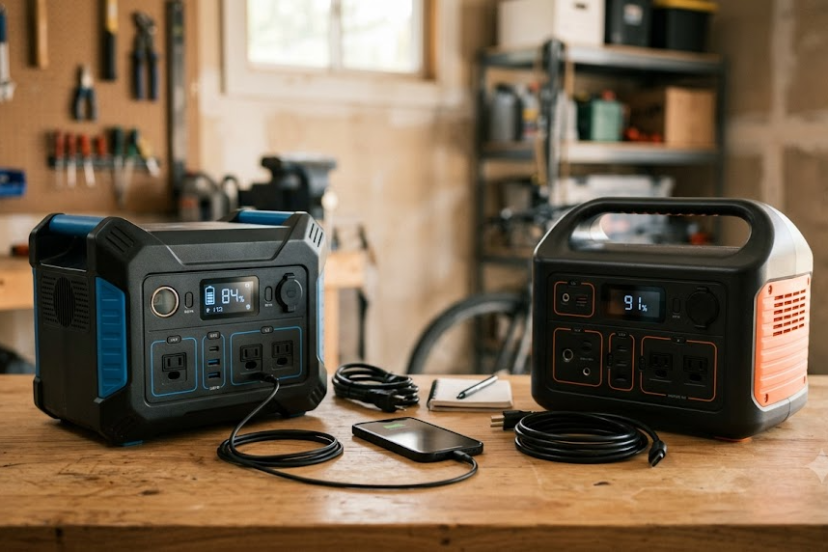
Quick Answer: If you want the fastest recharge, the highest power output, and room to expand later, EcoFlow is the stronger pick. If you want a simpler buying experience, dependable performance, and often better value for essential-only backup, Jackery is the safer choice. Most preppers do fine with either brand at the right size class.
J.T. Wilder | Survival strategist, Survival Tactix | Last updated: September 28, 2026
Jump to: The Short Version · Charging Speed: Where EcoFlow Pulls Ahead · Power Output: Which Handles Bigger Loads · Battery Chemistry and Long-Term Reliability · Solar Ecosystem and Recharge Flexibility · App and Smart Features · Price and Value for Everyday Preppers · Which Should You Buy? · FAQ · Next Step
Quick Picks
| Your priority | Pick |
|---|---|
| Fastest recharge, most output, room to expand into home backup | ⚡ EcoFlow |
| Simpler buying decision, proven solar ecosystem, essentials-only value | 🔋 Jackery · Canada |
| Phones, lights, radio, Wi-Fi through an outage | 🏠 Either: size it to your needs |
Disclosure: As an Amazon Associate, SurvivalTactix earns from qualifying purchases. Some links may also be affiliate links (EcoFlow, Jackery). This supports the site at no extra cost to you.
Compare current prices: Amazon (US) / Amazon (CA)
The Short Version
EcoFlow and Jackery are the two names you’ll run into most often when shopping for backup power, and both make genuinely solid gear. The real question isn’t “which brand is better”: it’s which one matches how you’ll actually use it. This guide breaks down the differences that matter for preparedness specifically, not for camping influencers.
This isn’t hypothetical: a nor’easter on September 27 left more than 130,000 customers without power across the Northeast, with New Jersey and New York both declaring states of emergency, and no hurricane involved. Whichever brand you land on, having one ready before the next storm system beats shopping for one after.
Charging Speed: Where EcoFlow Pulls Ahead
EcoFlow’s fast-charging technology gets most of its stations from empty to nearly full over AC power in under an hour on many models. Jackery’s charge times vary a lot by model: older units like the Explorer 500 and 1500 still take several hours, but newer v2 and Ultra models (Explorer 600 v2, 1000 v2, 1500 Ultra) now charge in as little as 1–1.5 hours, closing most of that gap on recent releases. For preparedness, this matters most in a specific scenario: a short window of grid power between outages, where you want to top off fast and be ready for the next one.
Power Output: Which Handles Bigger Loads
EcoFlow’s higher-end units generally lead on raw continuous output and surge capacity, which matters if you’re planning to run power tools, space heaters, or larger appliances during an outage. Jackery’s comparable units are usually a step behind on peak output: plenty for phones, lights, routers, and CPAP-class devices, but worth checking against your specific higher-draw devices before buying.
Battery Chemistry and Long-Term Reliability
Both brands have shifted most of their current mid-size and large units to LFP (LiFePO4) battery chemistry, which is the safer, longer-lasting option and the one worth prioritizing for a unit you want to trust in an actual emergency. Older or budget-tier models on either brand may still use standard lithium-ion: check the specific listing before buying, not just the brand name. The Consumer Product Safety Commission’s lithium-ion battery guidance is worth a skim regardless of which chemistry you land on: use only the charger that came with the unit, never charge it unattended overnight, and stop using any unit that shows swelling, unusual heat, or a burning smell.
Solar Ecosystem and Recharge Flexibility
Jackery’s solar panel lineup (see it on Amazon.ca) is widely regarded as reliable and well-built, and tends to bundle competitively with their power stations: a real advantage if solar charging is a priority for you. EcoFlow’s ecosystem is broader and built to scale into larger expandable home-backup systems if you think you’ll want to grow capacity over time.
App and Smart Features
EcoFlow’s app generally offers more detailed monitoring: battery health, input/output tracking, and smart scheduling. Jackery’s app (on newer models) is simpler and more focused on basic status checks. If you want to fine-tune how your system charges and discharges, EcoFlow has the edge. If you want something you set up once and mostly ignore, Jackery’s simplicity is a feature, not a limitation.
Price and Value for Everyday Preppers
Jackery is generally positioned as the better-value, simpler entry point: a strong fit if your goal is dependable essentials-only backup without over-buying. EcoFlow’s extra performance and expandability usually come at a premium, which makes more sense if you’re building toward a larger home-backup system rather than a single portable unit. Compare current listings directly: prices shift often on both brands. EcoFlow’s Prime Big Deal Days sale runs through October 18, with the deepest discounts on October 6 and 7.
Which Should You Buy?
Choose EcoFlow if: you want the fastest recharge, the most raw power, or you’re thinking about scaling into a larger home-backup system down the road.
Choose Jackery if: you want a simpler buying decision, a proven solar ecosystem, and strong value for essentials-only backup. Canadian readers can check it on Amazon.ca.
Either brand works if: your goal is realistic, covering phones, lights, radios, Wi-Fi, and a few critical essentials running through an outage. Don’t let brand-loyalty debates online distract from sizing correctly for your actual needs; see our full sizing guide for that.
A Word of Encouragement: Whichever brand you land on, remember: the goal isn’t to buy the most powerful unit on the shelf. It’s to make sure the people in your home aren’t sitting in the dark, out of contact, or without a way to keep essential devices running when the grid hiccups. Start with the size and brand that fits your actual life, not someone else’s kit list. You can always add capacity later: most preparedness wins come from getting something reliable in place now, not waiting for the “perfect” setup.
How to Size Either Brand to Your Actual Outage
Most buying regret in this category comes from picking a number that sounded impressive rather than one that matched the job. The arithmetic is simpler than the marketing suggests. Add up the watt-hours you actually need per day, then buy a battery about 30 percent larger to allow for inefficiency, cold weather, and the fact that you should not routinely drain a battery to zero.
A phone is roughly 15–20 watt-hours per full charge. A laptop is usually 50–80. An LED lamp running all evening is around 30–50. A Wi-Fi router left on around the clock is often 100–250 per day. A CPAP without a humidifier is commonly 200–400 per night, and considerably more with the heated humidifier switched on. Add your own numbers rather than trusting a general estimate, because device labels vary enormously.
Once you have a daily figure, the size classes sort themselves out. Under about 300Wh covers phones, lights, and a radio for a couple of days: genuinely useful, and enough for the outages most households actually experience. Roughly 500–1000Wh is the sweet spot for a medical device, a router, laptops, and lighting across a multi-day outage. Above about 1500Wh you are into fridge backup and partial home resilience, which is a different budget conversation and usually needs solar input to be worth it.
The refrigerator question deserves particular care. A fridge does not draw its rated wattage continuously (it cycles), but it does draw a large surge when the compressor starts. Check the surge or peak rating on any unit you are considering, not just the continuous rating, or you will buy something that trips the moment the compressor kicks in.
When Neither Brand Is the Right Answer
Both companies make good equipment, and neither is the correct purchase for every situation. Being straight about that is more useful than pretending a battery solves everything.
If you need to run high-draw resistive loads (electric heat, a well pump, a full-size air conditioner, power tools) through outages lasting several days, a portable power station is the wrong tool. That is generator territory, with all the fuel storage, maintenance, and carbon-monoxide discipline a generator demands. If you go that route, read our power outage preparedness guide first, particularly the generator-placement section, because CO poisoning kills people every storm season and it is entirely preventable.
If your outages are short and infrequent, a large power station may be more purchase than the problem warrants. A quality power bank, a good lantern, and a hand-crank radio cover a surprising amount of ground for a fraction of the cost. Spend the difference on water storage and a proper first aid kit, which almost every household under-invests in.
And if backup power exists mainly to keep a medical device running, treat that as its own project rather than a feature of a general kit. Confirm the exact draw with the device manufacturer, buy deliberate excess capacity, keep a second charging path, and talk to your provider about a backup plan that does not depend on electricity at all.
Mistakes to Avoid With Either Brand
A few patterns come up repeatedly, and all of them are avoidable.
Buying it and never testing it. A power station you have not actually used is an assumption, not a plan. Run your real devices off it once, on a calm evening, before you ever need it. That single hour tells you more than any comparison article, including this one.
Storing it fully charged or fully empty for months. Lithium batteries prefer to sit near the middle of their range. Check the manufacturer’s storage guidance for your specific unit and top it up on a schedule rather than forgetting about it until a storm is forecast.
Forgetting the cables. The station is useless if the one cable your device needs is in a drawer somewhere. Keep the charging cables you actually depend on physically with the unit.
Assuming solar is fast. Panel output in real conditions (imperfect angle, cloud, winter sun) is routinely well below the rated figure. Solar is excellent for extending a battery across a long outage. It is poor as your only plan for refilling one quickly.
Charging either brand safely (Fire Prevention Week, Oct 4–10): This year’s National Fire Prevention Week theme, “Charge into Fire Safety: Safe Charging Is a Superpower,” applies to any lithium-ion power station, EcoFlow or Jackery alike. The Consumer Product Safety Commission’s guidance: stay present while it charges and never charge it overnight while you sleep, use only the cable and adapter it came with, and unplug it once it reaches full rather than leaving it on trickle charge for days. If a unit ever feels unusually hot, swells, or smells off, stop using it.
FAQ
Is EcoFlow or Jackery better for beginners?
Jackery, generally: its simpler lineup and app make the buying and setup decision easier if this is your first power station.
Which brand charges faster?
EcoFlow, on most comparable models, thanks to its fast-charging technology.
Can I mix brands (Jackery panels with an EcoFlow station, for example)?
Not usually recommended. Solar inputs are often proprietary to each brand’s connectors and charge controllers: check compatibility specs before assuming panels are interchangeable.
Do both brands use safe battery chemistry?
Most current mid-size and large units from both brands use LFP (LiFePO4), the safer long-term option. Budget or older models may not: check the specific listing, not just the brand.
Which is the better long-term investment for home backup?
EcoFlow, if you’re planning to scale up capacity over time thanks to its more expandable ecosystem. Jackery, if your needs are stable and essentials-focused.
Already own a car kit, or building one? Both brands also sell compact automotive jump-starter units built on the same battery tech as their home power stations. Worth a look if you want a matching ecosystem. See our Vehicle Emergency Kit guide for the full breakdown of what else belongs in your car.
Next Step
Pick the brand that matches how you’ll actually use it, then size correctly using our full solar generator buying guide. Check current pricing directly: EcoFlow (US) • Jackery (US) • Jackery (CA) • Amazon (US) / Amazon (CA).
Preparedness information is for general education. Follow manufacturer instructions, local electrical rules, and official safety guidance.
Sources referenced: Ready.gov Power Outages · CPSC Lithium-Ion Battery Safety
Related: If a heat wave knocks out your power, see our No-AC Survival Guide for Blackout Season for how to stay cool without electricity.