The Offline Emergency Binder: What to Print Before Your Phone and Accounts Go Dark
Quick Answer: An offline emergency binder is a printed copy of what you would need if your phone, apps or internet were down for days: contacts, customer-service numbers for your accounts, insurance details, medications and a cash plan. Build it in about an hour, update it twice a year, and keep a duplicate of the key pages in a fire-resistant bag.
J.T. Wilder | Survival strategist, Survival Tactix | Last updated: October 5, 2026
This article is for general preparedness planning only and is not financial, legal, or medical advice. Survival Tactix may earn a commission from qualifying purchases made through links on this page, at no extra cost to you.
Jump to: Why a binder | What goes in it | What to leave out | How to build it | Where to keep it | FAQ
Why keep a paper binder when everything is on your phone?
Here is the catch with keeping everything on your phone: the phone is the first thing to fail in the situations this site plans for. In September, Hilltop National Bank in Casper, Wyoming reported IT problems on the 8th, traced them overnight to what it calls a “cybersecurity incident,” and took its systems offline as a precaution. In its September 9 evening update, the bank told customers their debit cards were good for up to $1,000 a day and that payments scheduled through the bank would not go out at that time. Personal mobile banking came back on September 21, online banking on September 23, and the bank’s last update, on September 24, said all systems were operational (Hilltop Bank update page). Local news coverage reported the same incident and the September 21 restoration.
That is one regional bank, not a national emergency, and it still meant about two weeks of customers working around a bank they could not log into. So what do you do when the number you need is saved in an app that will not open? You reach for paper. A printed page with the right phone numbers works the same whether the outage lasts an hour or two weeks.
Our household cyberattack preparedness plan covers the bigger picture of an outage week, and our family digital security guide covers locking down the accounts themselves. This article is the piece in the middle: a physical, offline backup for the information you would otherwise only ever look up on a screen.
It is not a new idea, either. Ready.gov publishes a free Emergency Financial First Aid Kit built on the same logic: your insurance policies, bank account information and key records and contacts gathered in one secure place so you can recover faster. Its Make a Plan guidance includes a step for writing your household plan down. We are packaging those ideas into something you can finish in a weekend.
Want the fastest path to a finished binder? We built a free, ready-to-print version so you do not have to design one from scratch.
What actually goes in an offline emergency binder?
Think of it as seven short sections, each answering one question you would otherwise have to look up on a screen.
- Household contacts. Every adult’s cell and work number, plus one out-of-area contact everyone in the house can check in with.
- Bank, card and utility numbers. The customer-service phone number and an account identifier for each bank, credit card and utility, so you can call from a landline or a borrowed phone. Never write down a PIN, a password or a full card number (more on that below).
- Insurance. Policy numbers and agent phone numbers for home or rental, auto and health coverage.
- Medications and medical contacts. Each household member’s medications, doses, prescriber and pharmacy phone number.
- A cash plan. How much cash you keep on hand, in what bills, and where it lives. The cash section of our household cyberattack plan covers the thinking behind it.
- A meeting and communication plan. Where the household meets if phones are down, and who calls whom. Ready.gov’s Make a Plan page is a good outline.
- A first-24-hours checklist. The few things to do first: call the bank on its known number (never one from a text message), watch accounts for fraud once systems return, and confirm which bills are due that week.
The binder itself lives on a shelf everyone knows about. A duplicate of the three pages you would grab first (contacts, insurance, medications) belongs in a fire-resistant, water-resistant bag with your passports and birth certificates, because the same events that knock out your phone, like a fire, a flood or a burst pipe, can also threaten the house.
Fire-Resistant Document Bag
Where the duplicate key pages, passports and birth certificates live. The US and Canadian listings are different bags with different sizes and fire ratings, so check the dimensions on the listing against what you plan to store.
What should never go in the binder?
A binder that falls into the wrong hands should not hand someone your financial life. Leave out full card numbers, PINs, online banking passwords, and your social security or social insurance number written in full. Account identifiers (the last four digits, the account nickname, the customer-service number) are enough to get you or a family member talking to the right institution. If you want a password backup, an encrypted USB drive is a better home for it than paper, and it can go in the same bag as the duplicate pages.
Encrypted USB Drive
For password backups and scanned copies of documents you do not want sitting on paper. This one is hardware-encrypted and protected by a passphrase, so a lost drive is far harder for a stranger to read. It costs more than a basic drive, which is the trade for the encryption.
How do you put one together this weekend?
- Print our free Household Outage Binder template (the form above), or sketch your own seven-section outline from the list in this article.
- Gather statements, or log in to each account once, to copy down the customer-service number and the account identifier. Do this in one sitting. It is the slowest step.
- Slide each page into a sheet protector so the binder survives being handled by every adult in the house, more than once.
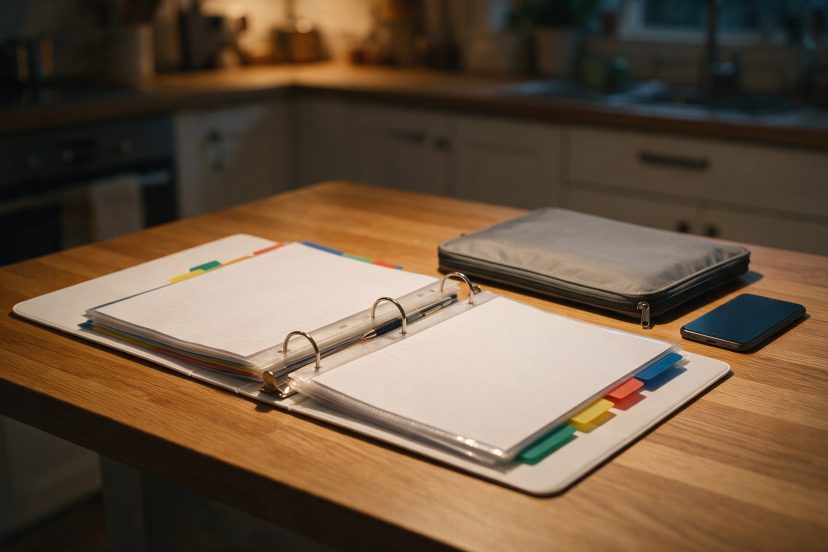
- Put the pages in a 3-ring binder, then make a duplicate of the contacts, insurance and medication pages for the fire-resistant bag.
- Set a recurring reminder for April and October to update phone numbers, policy numbers and medications.
Sheet Protectors and 3-Ring Binders
The sheet protectors come in a 100-pack and the binders in a 4-pack, which is enough for your own binder, a copy for the relative who holds your second set, and spares.
Where should you keep it, and who else should have a copy?
Keep the binder somewhere every adult in the household knows, not hidden where only one person remembers. A closet shelf or a cabinet near where you grab your keys works better than a safe only one person can open. If you have family in another city, a second copy with them is cheap insurance against a house fire or flood taking your only set. When pages get replaced, do not just toss the old ones in the recycling. A page with real account details belongs in a shredder, not in a bin a stranger could dig through.
If you would rather lock the key pages away than just bag them, a small key-lock fire-resistant box does both jobs at once and has a handle for grabbing on the way out the door.
Fire-Resistant Lock Box
A locking alternative to the document bag, for households that want the key pages secured as well as protected.
Cross-Cut Paper Shredder
For retiring old statements and outdated binder pages safely once you have updated your information. It also takes credit cards.
Is a binder enough? Not on its own. If the outage is a power cut instead of a bank problem, a small power station keeps a radio, a lamp and a phone charger running, and our EcoFlow vs Jackery comparison walks through the options. For the week-one view that ties the binder, your cash plan and your communication plan together, start with the household cyberattack preparedness plan.
If this list felt like a lot, look at what it actually asks of you: one hour, a handful of phone numbers and a binder on a shelf. You do not have to plan for every possible outage today. You only have to make one specific problem, being unable to reach the people and accounts you rely on, a good deal smaller than it was this morning. Most households never get this far, and that is exactly why finishing it counts.
Frequently asked questions
Is it safe to write down account numbers on paper?
Yes, if you write down account identifiers, not full numbers, PINs or passwords. Keep the binder somewhere not every visitor would look, and keep a duplicate of the key pages in a fire-resistant, water-resistant bag (US | Canada). The risk of a stranger finding your binder is much smaller than the risk of having no backup when your phone is the only copy.
What if I do not have a printer?
Most pharmacies, libraries and office-supply stores will print from a USB drive or an email for a small fee. Build the file once, bring it in, and print a copy for every adult who needs one.
How often should I update the binder?
Twice a year is realistic for most households. Pick two dates you already remember, such as when the clocks change, and treat the binder check like changing a smoke detector battery.
Does this replace a digital password manager?
No. A password manager is still the right tool for everyday logins. The binder is a backup for the specific situation where your phone, the internet or your bank’s systems are not working at all, which is exactly when a password manager app can also be out of reach.
Should kids know where the binder is?
Older kids and teens, yes, at least enough to know the household meeting plan and how to reach the out-of-area contact. Full account details are an adult-only section.
Next Step: Finish the Kit This Week
The document bag and the binders are the two pieces most households are missing. Picking up both in one order is the fastest way to finish this in a weekend instead of next month.
Sources
- Ready.gov, Emergency Financial First Aid Kit (EFFAK)
- Ready.gov, Make a Plan
- Ready.gov, Financial Preparedness
- Hilltop National Bank, Cyber incident update page
- County 10, Hilltop Bank restores personal and business banking services, September 25, 2026