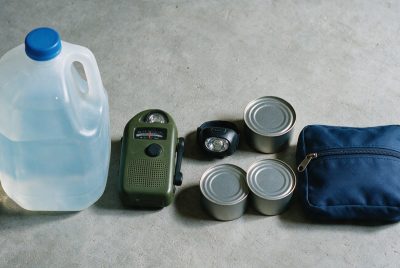
EMP Survival Kit: Build Faraday-Proof Essentials
J.T. Wilder | Survival strategist, Survival Tactix | Last updated: July 1, 2026
Ever wonder what would happen if the lights blinked out, phones died, and every screen around you froze, all at once? That’s the nightmare scenario people imagine when they hear “EMP.” While the topic can spark anxiety, your response doesn’t have to. With a thoughtful EMP survival kit, you can replace panic with a plan. This guide walks you through what to protect, what to pack, and how to practice so you’re ready for the kind of grid-down event that turns convenience into chaos.
Quick answer: what does an EMP kit actually need?
A solid EMP kit shields your critical electronics in Faraday bags or a lined metal container, keeps at least one backup radio, headlamp, and power bank protected as spares, and pairs that protection with the same 72-hour basics every household needs: water, food, first aid, and a written plan. Shield what matters, keep redundancy for your top three devices, and practice a drill at least once.
Fast track: If you want the shortest path, start with one phone-size Faraday bag for your spare phone, one larger bag or lined ammo can for your radio and headlamps, and a 10–20W folding solar panel. Everything else in this guide builds outward from that core.
Get the 72-Hour Checklist (email) Check gear prices (hub)
Disclosure: As an Amazon Associate, SurvivalTactix earns from qualifying purchases. Some links may also be affiliate links (Survival Frog). This supports the site at no extra cost to you.
Preparedness information is for general education. Follow manufacturer instructions and official safety guidance for your region.
Jump to: Quick answer • Faraday protection • Quick Picks: Faraday bags • What to shield • Power & lighting • Water & food • Vehicles • Mistakes to avoid • Resources • FAQ
What is an EMP, and why should you care?
An electromagnetic pulse (EMP) is a burst of energy that can damage or disrupt electronics and electrical systems. In fact, it can be man-made (for example, a high-altitude detonation) or natural (a severe solar storm that induces geomagnetic disturbances). Either way, the practical effect on everyday life is similar: communications fail, power grids falter, and modern logistics stumble.
You don’t need to fear every headline. Still, you do need to prepare sensibly, just like you would for hurricanes, ice storms, or wildfires. In short, an EMP kit is simply disaster readiness with a focus on protecting electronics and preserving essential functions like power, light, communication, water, and first aid.
EMP vs. solar storms: what’s the practical difference?
Both events threaten electronics; however, they don’t behave identically.
- High-altitude EMP (HEMP): Very fast rise time, wide area, strong coupling to long conductors. In particular, small devices can be affected, especially if connected to long wires (power lines, large antennas).
- Severe solar storm (CME): A slower-moving geomagnetic disturbance that drives large currents in long conductors (grid lines, pipelines). Household electronics not connected to long runs are generally less vulnerable, but power grid stability is at risk. The NOAA Space Weather Prediction Center tracks and forecasts these events much like the National Weather Service tracks storms.
So, what should you do? Prepare for both by protecting key electronics and planning for extended power outages.
EMP preparedness mindset: four guiding principles
Think of your EMP survival kit as a four-legged table. Strong stability comes from:
- Protect: Shield critical electronics and spares from damaging pulses.
- Power: Keep essential devices running without the grid.
- Provide: Meet core human needs: water, food, shelter, warmth, and medical care.
- Plan: Train, label, test, and maintain so your gear works under pressure.
Miss a leg, and everything wobbles.
Faraday protection 101: how do you actually shield your gear?
You’ll hear the term Faraday a lot. In short, it simply means creating a conductive enclosure that helps divert electromagnetic energy around, not through, your device.
Practical options:
- Purpose-built Faraday bags: Portable, simple, available in multiple sizes for phones, tablets, and radios.
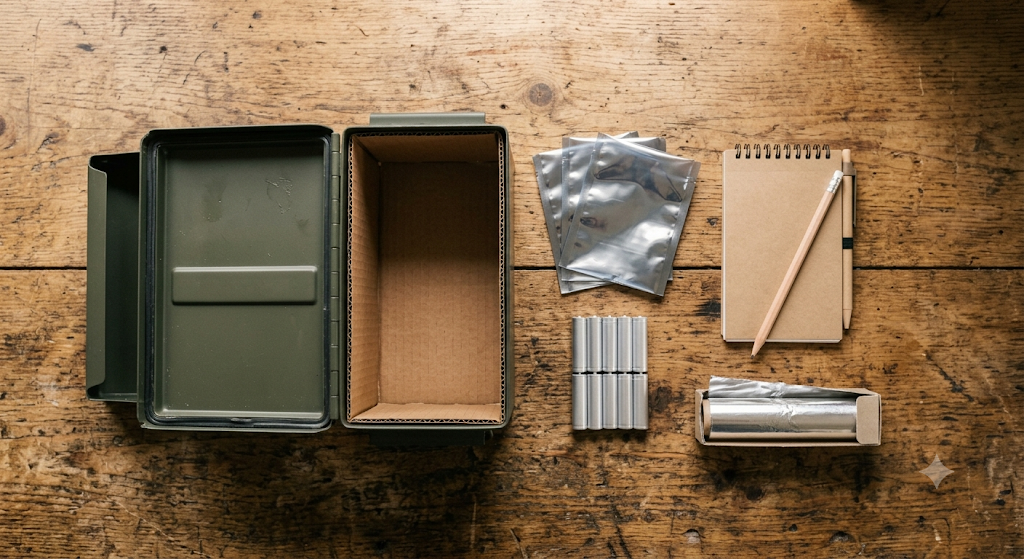
- DIY nested system: Device → anti-static bag → aluminum foil layer(s) → insulating layer (cardboard/bubble wrap) → metal ammo can with intact gasket or a latching metal bin.
- Metal trash can with lid: Line the inside with cardboard so gear doesn’t touch metal. Ensure the lid fits snugly.
- Grounding? For portable Faraday containers, it’s typically not necessary; focus more on continuous conductive coverage and no direct contact between device and metal.
Pro tip: Use redundant layers for your most vital electronics. Also, keep spare units stored separately to avoid a single point of failure.
Quick Picks: Faraday bags and EMP kit basics
You don’t need to buy every option below. Match the pick to the electronics you actually need to protect, then build outward as your budget allows.
| Best for | Pick | Why it earns the spot | Where to check price |
|---|---|---|---|
| Best overall / most complete kit | Mission Darkness Faraday Bag Bundle (Standard Collection): phone, tablet, laptop & keyfob sizes | Covers your whole electronics stack in one purchase; independently tested signal-blocking construction | Amazon US • Amazon Canada |
| Best for everyday carry (phone + keys) | Mission Darkness Non-Window Faraday Bag for Phones (2-Pack) | Protects your daily-carry phone and a spare/keyfob without bulk; easiest one to actually use daily | Amazon US • Amazon Canada |
| Best for outdoor gear & bulk electronics | Survival Frog Faraday EMP Dry Bag, 10L | Doubles as a waterproof dry bag for your radio, headlamps, and power bank: $50.97 direct from Survival Frog | Check price at Survival Frog |
| Best DIY / budget path | Latching metal ammo can + anti-static bags | Lowest cost per liter of protected storage if you’re willing to build the nested-layer system yourself | Amazon US • Amazon Canada |
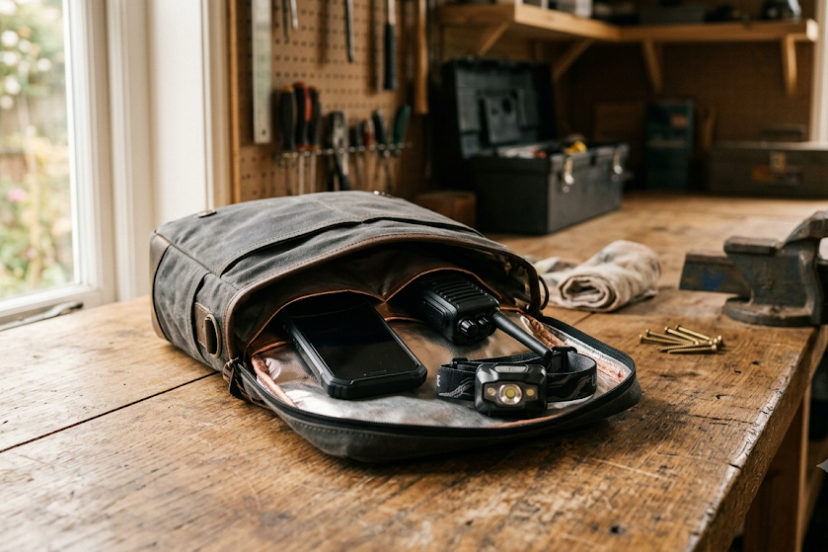
The core electronics to shield (and why they matter)
Which devices deserve Faraday priority? In short, the ones that protect life, restore power, or restore communication.
- Hand-crank/solar emergency radio (AM/FM/NOAA where available): see our Emergency Radio guide if you still need one
- Two-way radios (FRS/GMRS, or licensed amateur radios if you’re trained)
- LED headlamps and flashlights (with spare batteries)
- Solar charge controller and small folding solar panel
- Power banks (store at roughly 40–60% charge; rotate as part of maintenance)
- Spare phone (factory-reset with offline maps and PDFs)
- Tiny laptop/E-ink tablet (for documentation, maps, stored references, and diagnostics)
- Battery analyzer/USB multimeter (for troubleshooting and safe charging)
- Water purifier with UV (optional, if electronic; always carry a non-electronic backup)
These items are compact, powerful force multipliers. Therefore, the simplest rule is to store one to use now and one to keep protected.
Start here: shield the phone and a spare first, then work outward to the rest of the stack. Mission Darkness non-window Faraday bag, 2-pack: Check price (US) · Check price (Canada)
Power, lighting, and charging: what does your off-grid energy stack look like?
So, think of off-grid energy like a river system: generation flows to storage, then distribution.
Generation: Folding solar panel (20–100W class, depending on your needs), hand-crank generator, vehicle alternator (only if safe and functional). For a deeper look at sizing a full power station, see Best Solar Generators for Survival.
Storage: Quality power bank(s) for phones, radios, and headlamps; a 12V LiFePO₂ battery for extended setups; rechargeable AA/AAA cells (low self-discharge preferred).
Distribution & control: Solar charge controller (PWM/MPPT matched to panel and battery), DC-DC converters (12V → 5V USB, etc.), and cables clearly labeled by voltage and polarity.
Lighting: Headlamps for hands-free tasks, a lantern for room lighting, and a task light for repairs.
In other words, light extends your day, power preserves your tools, and reliable charging keeps you connected when information is scarce.
Water and food: what’s non-negotiable in a grid-down event?
Electrons matter; water matters more. Aim for at least 1 gallon (3.8 L) per person per day for drinking and minimal hygiene. For longer resilience:
- Filtration: Gravity filter, squeeze filter, or pump filter.
- Disinfection: Chlorine dioxide tablets or plain, unscented household bleach as a backup.
- Containers: Collapsible water bladders plus sturdy jugs for transport and storage.
Food should be shelf-stable, compact, and easy to prepare without electricity. Instead, consider ready-to-eat items (energy bars, nuts, dried fruit, jerky), dehydrated meals plus a way to heat water, and stove options (butane, alcohol, or solid fuel) with ventilation awareness and a carbon monoxide detector for enclosed spaces. For a deeper pantry plan, see Long-Term Food Storage.
Communication and navigation: how do you avoid being isolated?
Information is a survival tool. Indeed, in a communications blackout, simple radio becomes priceless.
- Emergency radio for news and weather bulletins
- Two-way radios for family coordination
- Signal mirror and whistle for low-tech signaling
- Printed neighborhood maps, plus offline maps on your protected device
- Notebook and pencils for logging, messages, and checklists
Establish pre-planned channels and rendezvous times. Also, practice radio etiquette and brevity to conserve battery power and keep channels clear. For a full breakdown, see Why Communication & Navigation Are Critical.
Medical and safety: how do you stabilize, then sustain?
A strong EMP kit includes a robust first-aid setup. So, build yours in layers:
- Trauma: Tourniquet, pressure dressing, hemostatic gauze
- Basic care: Bandages, antiseptic, sterile pads, tape
- OTC medications: Pain relief, antihistamines, anti-diarrheals, rehydration salts
- Tools: Nitrile gloves, shears, thermometer, CPR barrier
- Reference: A small, printed first-aid guide
Also, add PPE like N95 masks, safety glasses, and work gloves. After all, safety scales capability; injuries steal time and energy you can’t spare.
Tools, repair, and redundancy: how do little fixes add up to big wins?
A compact repair kit turns a problem into a pit stop: multitool and fixed-blade knife, duct tape and electrical tape, zip ties, paracord, and wire, a small hardware assortment (nuts, bolts, hose clamps), a mini tool roll (drivers, hex keys, small adjustable wrench), spare fuses for critical gear, and a fire kit (ferro rod, storm matches, tinder).
Redundancy isn’t wasteful here. Indeed, two ways to light a fire and two ways to purify water add resilience when conditions get messy.
Clothing, shelter, and comfort: why does morale count as a resource?
Disasters deplete energy and willpower. Stay warm, dry, and rested with layered clothing appropriate to your climate, a rain shell and insulating mid-layer, wool socks and sturdy footwear, an emergency bivy or compact sleeping bag, and a lightweight tarp with cordage for quick shelter.
Also, small comforts, like a compact steel mug, tea bags, or a deck of cards, lift spirits and help maintain calm decision-making.
Critical documents and analog backups: what happens when screens fail?
When screens fail, paper prevails. Keep a printed contact list for family, neighbors, and local responders, copies of IDs, insurance, and prescriptions, local maps with marked routes, water sources, and aid locations, and written SOPs (standard operating procedures) for your household: who does what, when, and in what order.
Additionally, store paper in waterproof pouches and add a laminated quick-start card for your EMP kit.
Vehicles and EMP: what can you actually control?
Will your car start after an EMP? The honest answer is: it depends (vehicle design, intensity, proximity, and many variables). Focus on what you can control: keep a paper map, spare fuses, and a basic tool kit in the vehicle, store a handheld radio and headlamp in a small Faraday pouch inside the car, maintain a half-tank minimum as a family rule, and carry water, snacks, blankets, and a tire repair kit with pump.
In short, preparedness beats conjecture every time.
Apartment, suburban, and rural versions: how should your kit change by setting?
A one-size EMP kit doesn’t exist. Tailor by setting:
- Apartment: Emphasize compact storage, noise/odor discretion, and portable power. Choose a small solar panel, a quiet lantern, and collapsible water containers.
- Suburban: Add larger water storage, a bigger panel or two, and a neighborhood comms plan.
- Rural: Consider 12V battery systems, more extensive spares, and tools for repairs at a distance.
Overall, the principles stay the same; only the scale shifts.
Family-ready kit: what do kids, elders, and pets need?
People aren’t interchangeable. Account for kids (smaller headlamps, labeled pouches, comfort items, clear job cards), elders (extra medications, simple controls, readable labels, stable seating), and pets (food, water, leash, carrier, and vaccination records).
So, assign roles so everyone contributes and stays engaged.
Training and drills: what does a 72-hour EMP exercise look like?
Gear doesn’t save you. Practice does. Run a weekend “grid-down” drill: kill the breakers (or simulate by avoiding outlets) for 24–72 hours, use only your EMP kit for light, power, and comms, keep a log of what failed, what worked, and what ran out, then update the kit immediately afterward.
In fact, you’ll learn more in one drill than in ten hours of reading.
Maintenance: how do labels, rotation, and readiness keep your kit alive?
Preparedness is a habit, not a checkbox. Label every cable with destination and voltage, date your batteries and set a rotation schedule (quarterly works for most households), re-seal Faraday containers after testing and keep spare anti-static bags on hand, and keep a one-page inventory checklist taped inside the lid.
In the end, small systems prevent big surprises.
Good, better, best: what does a budget-friendly build path look like?
Good (starter): Faraday bags (2 sizes), hand-crank/solar radio, LED headlamp plus spare batteries, compact folding solar panel (~20W), 10,000–20,000 mAh power bank, two-way radios, basic first aid, water filter plus tablets, maps, whistle, multi-tool.
Better (expanded): Nested Faraday solutions (bag plus lined metal can), second radio set, two headlamps per adult, 40–60W panel with charge controller, LiFePO₂ power station or 12V battery, rechargeable AA/AAA ecosystem, larger gravity water filter, trauma kit, lantern, printed SOPs, DC-DC adapters.
Best (resilient): Multiple protected spares, 80–100W+ solar with MPPT controller, modular 12V system, battery analyzer, spare phone with offline docs, small rugged laptop/E-ink reader, neighborhood comms plan, staged vehicle kit, robust shelter system, labeled cable tree.
Choose the lane that fits your budget today, and then upgrade deliberately.
Packing, organization, and common mistakes
When stress spikes, organization saves minutes, and minutes matter. Color-code pouches (red for medical, blue for water, yellow for power, green for tools), keep top-layer access to headlamps, gloves, radio, and first aid, tape an inside-lid quick-start card (“1) Headlamps on 2) Radio scan 3) Check water 4) Deploy panel”), use dry bags for water and weather protection, and add silica gel packs to limit moisture in Faraday containers.
Common mistakes worth avoiding: over-reliance on generators without fuel, filters, or CO safety plans; no redundancy for critical functions (only one way to purify water); unlabeled cables that turn setup into guesswork; no practice until the day it counts; and unprotected spares stored next to in-use gear. So, eliminate these early, and your odds improve dramatically.
EMP myths: a quick reality check
“Everything electronic will be toast.” Not necessarily. Vulnerability varies. Shield what’s essential and plan for outages. Don’t assume universal destruction.
“Grounding is mandatory for portable Faraday containers.” Not in most household use cases; continuous conductive coverage and insulation matter more.
“If my car doesn’t start, nothing else matters.” Not true. Neighborhood-scale cooperation and personal readiness still drive outcomes.
In short, preparedness thrives on realism, not extremes.
A simple, action-ready checklist
- Radio (crank/solar) + spare
- Two-way radios + batteries
- Headlamps ×2 per adult + lantern
- Folding solar panel + controller + labeled cables
- Power bank(s) + rechargeable AA/AAA
- Water filter + tablets + containers
- 72-hour food + safe cooking method
- First-aid + trauma items
- Maps + printed contacts + SOPs
- Multitool, tape, cordage, fire kit
- Clothing layers, rain gear, emergency bivy
- Faraday protection for spares
- Run a 24–72 hour drill and update
A Quick Word of Encouragement
If this list feels like a lot, you don’t have to build it all this weekend. Most households who feel truly ready didn’t buy everything at once: they picked one device to protect, one drill to run, and one habit to repeat until it stuck. Start with a single Faraday bag for your spare phone and a backup radio. In fact, that alone puts you ahead of almost everyone who hasn’t thought about this at all. Instead, the goal isn’t a perfect kit; it’s a household that stays calm and capable when the power and the noise both go quiet. So, add one layer at a time, and let progress replace pressure.
Calm is a kit you build in advance
An EMP survival kit isn’t exotic. It’s a well-organized, EMP-aware disaster kit that protects critical electronics and preserves the essentials: power, light, water, communication, medical care, and shelter. Start small, shield what matters, and practice until setup is muscle memory. Then, you’ll gain confidence one labeled cable and one weekend drill at a time. So, when others freeze, you’ll move: quietly, quickly, and effectively.
FAQ: EMP survival kits
Do I really need Faraday protection if I’m preparing mainly for solar storms?
It’s still smart. After all, severe solar events threaten the grid first, yet layered shielding for small, vital electronics is inexpensive and adds resilience across scenarios.
How often should I rotate batteries and test my kit?
A quarterly check works for most households. In particular, top up power banks, test radios, verify your solar panel/charge controller pairing, and re-seal Faraday containers.
What should I protect first if my budget is tiny?
First, prioritize communication and light: an emergency radio, a headlamp, and a small solar panel with a modest power bank. Then, add a water filter immediately after.
Will my vehicle be affected by an EMP?
Outcomes vary. Because you can’t control the scenario, focus instead on what you can control: carry maps, lights, radios, basic tools, and keep your fuel level up.
How big should my solar setup be?
Size it to what you must power: radios, lights, and a phone need far less than a fridge. As a result, many households function well with 40–100W folding panels plus right-sized storage.
Do Faraday bags actually block an EMP, or just RFID and Wi-Fi signals?
A well-made Faraday bag with continuous conductive shielding and a proper seal attenuates a broad range of electromagnetic energy, not just RFID and Wi-Fi. That said, no consumer bag is independently EMP-certified in the way military shielding is tested, so redundancy (a protected spare, plus a lined metal container as backup) still matters more than trusting any single product.
Trusted resources and related guides
Trusted external resources
- NOAA / NWS Space Weather Prediction Center
- Ready.gov: Build a Kit
- FEMA: Generator Safety
- Government of Canada: Emergency Kits
Related SurvivalTactix guides
- Being Prepared for Emergencies
- Emergency Radio with Solar and Hand Crank
- Best Solar Generators for Survival
- Long-Term Water Storage
- 72-Hour Emergency Kit Gear Hub
- EMP Survival Interview: Expert Advice & Action Plan
Next step
Pick one device, protect it today, and build outward from there.