Wildfire Smoke Preparedness: How to Keep Your Home’s Air Safe (Even in an Apartment)
Quick Answer: Wildfire smoke preparedness comes down to four moves when smoke moves in: keep it outside (close windows and doors, seal obvious gaps), clean the air in one room with a HEPA purifier or a $40 DIY box-fan filter, watch the AQI and stay indoors when it climbs past 150, and wear a well-fitted N95 if you must be outside. Stock two weeks of filters before smoke season, not during it.
J.T. Wilder | Survival strategist, Survival Tactix | Last updated: July 11, 2026
Jump to: What smoke does to your body · Keeping smoke out · The one-clean-room setup · Purifier vs. the $40 DIY filter · Reading the AQI · Apartments and rentals · Shelter or evacuate · Gear · FAQ · Bottom line
Disclosure: As an Amazon Associate, SurvivalTactix earns from qualifying purchases. Some links may also be affiliate links. This supports the site at no extra cost to you.
Wildfire smoke preparedness is no longer just a West Coast concern. In recent seasons, smoke from fires in Canada and the western U.S. has pushed air quality alerts across the Midwest, the Northeast, and much of southern Canada — often in places where nobody owns an air purifier and nobody has thought about smoke before. The good news: protecting your household’s air is one of the cheapest, most doable pieces of preparedness there is. This guide walks through it calmly, step by step.
What Does Wildfire Smoke Actually Do to Your Body?
The main hazard in wildfire smoke is fine particulate matter, called PM2.5 — particles small enough to bypass your nose and throat and settle deep in the lungs, where they can pass into the bloodstream. Short-term exposure commonly causes stinging eyes, scratchy throat, coughing, and headaches. For sensitive groups — children, older adults, pregnant women, and anyone with asthma, COPD, or heart disease — smoke days measurably increase ER visits.
Two practical takeaways follow from this. First, you cannot filter PM2.5 with a bandana, a dust mask, or a damp towel — it takes a true HEPA filter or a properly fitted N95-class respirator. Second, the goal isn’t zero exposure; it’s cutting the dose. Every hour spent in cleaner air matters.
How Do You Keep Wildfire Smoke Out of Your Home?
The first job in any wildfire smoke preparedness plan is simple: keep as much of it outside as you can.
Think of your home the way you’d think of a boat: you can’t make it perfectly watertight, but you can slow the leaks dramatically.
- Close windows and doors before smoke arrives, not after you smell it. If a smoke plume is forecast for your area, seal up early.
- Set HVAC to recirculate. If you have central air, switch it to recirculate mode and upgrade the furnace filter to MERV-13 if your system supports it (check your manual — some older blowers strain against denser filters).
- Skip anything that pulls outdoor air in: window fans, bathroom and kitchen exhaust fans running for long stretches, and dryer runs you can postpone.
- Seal the obvious gaps. A rolled towel at a leaky door bottom and painter’s tape over a whistling window gap are crude and effective.
- Don’t add indoor smoke. On bad air days, skip candles, incense, frying, and anything else that generates particles indoors.
How Do You Set Up One Clean-Air Room?
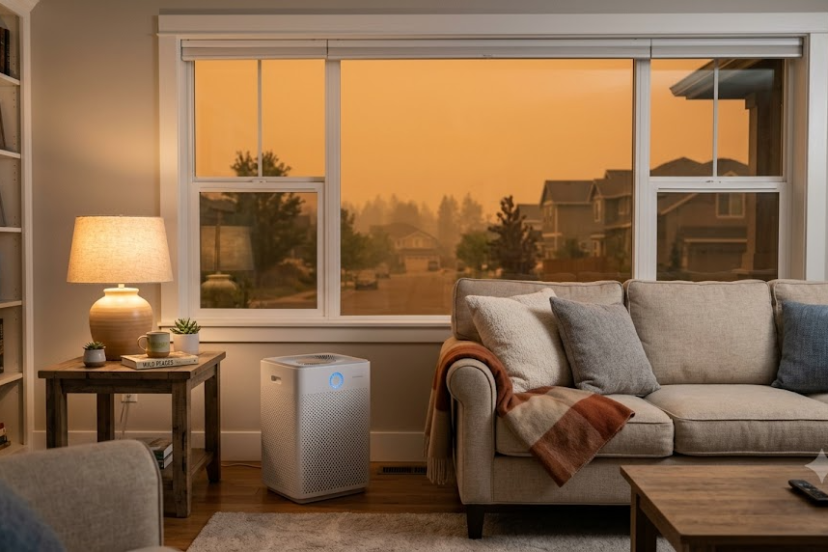
If you only do one thing on this page, do this. A single clean-air room is the highest-value step in household wildfire smoke preparedness, and it works in a rental just as well as it does in a house.
Trying to clean the air in an entire house is expensive and usually unnecessary. The strategy public health agencies recommend — and the one that works in real households — is a single clean room where your family spends most of its time during smoke events.
- Pick the right room. A bedroom with few windows, or the room where your family already gathers. Ideally one with a door that closes.
- Seal it the same way you sealed the house — windows shut, gaps stuffed, door closed as much as traffic allows.
- Run filtration continuously — a HEPA purifier sized for the room, or the DIY build below. Continuous operation matters more than raw power; air quality rebounds fast when filtration stops.
- Put comfort in the room: water, snacks, chargers, games for kids. If people drift out because the room is boring, the plan fails.
If you also lose power during a smoke event — increasingly common when fires and heat waves overlap — a battery power station can keep a purifier running. A typical portable HEPA unit draws modest wattage, which is exactly the kind of load a well-sized solar generator handles for hours.
What’s the Best Air Purifier Setup (and the $40 DIY Alternative)?
The bought option: a portable air cleaner with a true HEPA filter, sized to your room. Manufacturers publish a CADR (Clean Air Delivery Rate) — as a rule of thumb, match the unit’s rated room size to your actual room, and go one size up if you can. Avoid ozone-generating “ionizers” as a primary tool. Browse current options and prices here: HEPA purifiers (US) / Canada.
The DIY option: a box fan with a MERV-13 furnace filter attached to the intake side — about $40 total, and in EPA and independent testing these builds meaningfully reduce indoor PM2.5. The four-filter “Corsi-Rosenthal box” version performs even better. Two practical notes: use a fan made after 2012 (newer fans have fused motors that make the setup safer), and don’t leave any DIY build running unattended for days on end — check the filter and motor warmth periodically. Parts: MERV-13 filters (US) / Canada and any standard 20-inch box fan.
Either way, buy filters early. When smoke hits a region, purifiers and filters sell out within a day or two — the same dynamic as generators before a hurricane. Two weeks of replacement capacity, purchased in the off-season, is the whole game.
Get the Smoke-Ready Home Checklist (free PDF)
Everything in this guide on two printable pages — the pre-season shopping list, the seal-the-house steps, the one-clean-room setup, and the AQI cheat sheet. Stick it on the fridge and be ready before the first smoky morning.
No spam. One useful email at a time. Unsubscribe whenever.
How Do You Read the AQI and When Should You Act?
Good wildfire smoke preparedness depends on knowing when to act, not only on what you own.
The Air Quality Index turns pollution measurements into one number. Check it at AirNow.gov (US) or via Environment Canada’s Air Quality Health Index. The bands that matter for smoke:
- 0–50 (Good) / 51–100 (Moderate): normal life; unusually sensitive people watch symptoms at the top of the range.
- 101–150 (Unhealthy for Sensitive Groups): kids, seniors, and anyone with heart or lung conditions cut back outdoor exertion; close the house up.
- 151–200 (Unhealthy): everyone limits time outdoors; clean room running; N95 for necessary trips outside.
- 201+ (Very Unhealthy / Hazardous): stay in, keep filtration running continuously, and check on vulnerable neighbors.
One caution: your nose is a poor sensor. Smoke that has traveled hundreds of miles can arrive with little smell while still carrying unhealthy PM2.5. Trust the number, not the smell.
What If You Rent or Live in an Apartment?
Renters often assume wildfire smoke preparedness needs a landlord’s permission. Most of it does not.
Renters can’t upgrade the building’s HVAC, and that’s fine — the clean-room strategy was practically invented for apartments. A smaller space is genuinely an advantage: one properly sized purifier can handle a studio or one-bedroom (US options / Canada). Focus on three things: seal your own unit’s windows and door gaps, run your purifier or DIY build in the room where you sleep, and skip the building’s shared spaces (lobbies, gyms, laundry rooms) on bad-air days — they leak. If your building uses through-wall AC units, set them to recirculate or off during peak smoke.
For the broader apartment-preparedness picture — water, power, and a 72-hour foundation — start with our 72-Hour Emergency Kit Gear Hub and the household preparedness guide.
When Should You Leave Instead of Shelter?
Sheltering from smoke works when the fire itself is far away. If there is an actual fire threat — an evacuation warning, ash falling, flames visible — leave early and treat it as a fire evacuation, not an air-quality event. Follow local emergency management, not social media.
Smoke can also justify a voluntary relocation: if AQI has been hazardous for days, your home is leaky, and someone in the household is high-risk, a few nights with family in a cleaner area is a legitimate preparedness move, not overreaction. Keep your vehicle kit stocked and fuel above half a tank during fire season so that decision stays easy. A packed go-bag — see Survival Frog’s ready-made options or build your own from the gear hub — removes the last bit of friction.
Gear That Supports Your Smoke Plan
You can cover this scenario well for under $150, and most of it does double duty for other emergencies:
- Good ($40–60): box fan + two MERV-13 filters + a few NIOSH-approved N95s (US) / (Canada).
- Better ($100–200): a true-HEPA purifier sized for your bedroom, spare filter, N95s for each family member.
- Best (build over time): purifier per bedroom, MERV-13 in the HVAC, a battery power station to run filtration through outages, and a packed evacuation bag.
A Word of Encouragement: Smoke season headlines can make this feel overwhelming, but this is one of the most solvable problems in preparedness. One closed-up room, one $40 fan-and-filter build, and a pack of N95s puts your household ahead of almost everyone on the block. Pick one step today — even just bookmarking AirNow — and build from there. If you’re a person of faith, take a breath and ask for calm and wisdom as you prepare. You’re doing better than you think.
Wildfire Smoke FAQ
Do air purifiers really help with wildfire smoke?
Yes. A true HEPA filter removes the fine PM2.5 particles that make smoke dangerous, and portable air cleaners measurably lower indoor particle levels when sized to the room and run continuously. They are the single most effective indoor tool during smoke events.
Does a DIY box-fan filter actually work?
Yes. A box fan with a MERV-13 furnace filter attached meaningfully reduces indoor PM2.5, and EPA testing supports the approach. Use a fan made after 2012, check it periodically while running, and replace the filter when it visibly darkens.
What AQI is unsafe for children?
Children are a sensitive group, so limits kick in earlier: reduce outdoor play from AQI 101, and keep kids indoors with filtration running once AQI passes 150. Watch for coughing or unusual fatigue regardless of the number.
Will an N95 protect me from smoke?
A NIOSH-approved N95 that seals well against your face filters the fine particles in smoke. Cloth masks, surgical masks, and bandanas do not. Fit matters more than brand — air that leaks around the edges is unfiltered air.
How long does smoke season last?
In the US and Canada, most smoke impacts occur from roughly June through October, peaking in late summer — but smoke can travel to regions far from any fire with little warning, so having filters on hand year-round is cheap insurance.
Should I run my air conditioner during smoke?
Yes, if it recirculates indoor air — central AC on recirculate and most window units on the recirculate setting are fine, and they help with the heat that often accompanies smoke. Avoid settings that draw in outside air.
Other seasonal threats: if you are on a coast as well as in smoke country, our hurricane evacuation guide covers evacuation zones, storm surge, and what to prepare before the season peaks.
The Bottom Line
Wildfire smoke preparedness is not complicated, and it does not have to be expensive to start.
You cannot control when smoke comes, but you can decide in advance what your family breathes. Seal the house before it arrives, run real filtration in one room, trust the AQI over your nose, mask properly when you must go out, and buy your filters before the whole region wants them. Do the $40 version this week; upgrade over time. That’s the entire plan — calm, cheap, and it works.
Get the Smoke-Ready Home Checklist (free PDF)
Everything in this guide on two printable pages — the pre-season shopping list, the seal-the-house steps, the one-clean-room setup, and the AQI cheat sheet. Stick it on the fridge and be ready before the first smoky morning.
No spam. One useful email at a time. Unsubscribe whenever.
Ready to close the gap: HEPA purifiers (US) / CA · MERV-13 filters (US) / CA · N95 respirators (US) / CA
Preparedness information here is for general education. Follow local emergency guidance and manufacturer instructions. For medical concerns, especially asthma, heart, or lung conditions, consult a qualified professional.
Sources referenced: EPA AirNow · EPA Wildfires & Indoor Air Quality · Ready.gov Wildfires · CDC Wildfire Smoke