No Cell Service, No Internet: A Family Communication Plan That Works Offline
Fast track
Ten seconds, two moves: pick your out-of-area contact, then see what actually works when the towers are overloaded.
Quick Answer: A family communication plan for a network outage has three parts: a way to talk to each other nearby that does not need a tower (two-way radios), a way to get information when the internet is down (a battery or hand-crank radio), and a way to reach people far away through a single out-of-area contact everyone has memorized. Agree on it, write it down, and put a copy in every wallet before you need it.
J.T. Wilder | Survival strategist, Survival Tactix | Last updated: October 19, 2026
On July 8, 2022, a maintenance update at Rogers Communications deleted a routing filter and took down phone and internet service for more than 12 million customers across Canada, including mobile 911 access in Rogers’ own network, for about a day. On February 22, 2024, an equipment configuration error during a routine AT&T network change blocked more than 92 million voice calls and kept over 25,000 calls from reaching 911 call centers for about twelve hours. Neither of those was a cyberattack. Both looked, from a kitchen table, exactly like one: no bars, no texts going through, no way to tell your spouse you were okay.
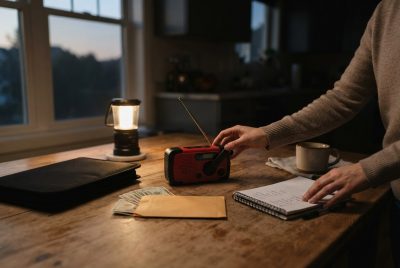
That is the gap this guide fills. Our household cyberattack plan covers what happens when a bank, pharmacy, or carrier goes down from the provider’s side. This article covers something narrower and more common: what your own household does, in the first hour, when the phones in your pocket stop being useful for talking to each other. A two-way radio like the one below solves a different problem than a satellite phone does, and most households own neither and have never written down a plan at all.
Disclosure: Survival Tactix is reader-supported. Some links on this page are affiliate links, including Amazon Associates and AWIN partner links. If you buy through them, we may earn a commission at no extra cost to you. We only recommend gear we’d actually put in our own kit. This article is educational and is not a substitute for guidance from your utility, carrier, or local emergency management office.
Why your phone isn’t a plan
A smartphone is three separate things wearing one case: a cellular radio that needs a working tower, a Wi-Fi radio that needs a working internet connection behind it, and a battery that needs power. A single outage, whether it is a cyber incident at the carrier, a configuration error like AT&T’s, or a storm that drops a cell tower, can take out all three at once for everyone in range. When that happens, “just call” and “just text” both stop being real options, often for hours and sometimes for days.
The Rogers outage is the clearest household-level example on record, because the disruption reached past phones into daily life: debit terminals stopped working nationwide for a day, some stores closed because they could not process payments, and transit and traffic systems in Toronto were affected. The AT&T outage showed the same pattern in the US: not a single dropped call here and there, but entire households suddenly unable to reach each other or reach 911 at the same moment. A family that already knows its three fallback moves does not need the network to come back on to get those first anxious hours right.
A plan is also a printed card, not just an idea
The Offline Emergency Binder has a page built for exactly this: contact numbers, meeting places, and the out-of-area contact, printed and in your bag before you need it. Our free printable Household Outage Binder below includes it.
What does a family communication plan actually include?
FEMA’s Ready.gov guidance (sourced below) breaks a family communication plan into four plain pieces, and none of them require a working network to set up in advance:
- An out-of-area contact. Someone outside your city or state who everyone calls or texts to check in, because long-distance routes sometimes work when local lines are jammed.
- A neighborhood meeting place. Somewhere close, like a mailbox or a neighbor’s porch, to gather if you have to leave the house.
- A meeting place outside the neighborhood. Somewhere to go if you’re away from home and can’t get back right away, such as a library or a friend’s place.
- A meeting place outside your town. Usually a relative’s home, for the rare case where the whole area is affected.
Write it on a card every household member can carry: full contact information for the out-of-area contact, the addresses of both meeting places, and a line for anyone with a disability, a pet, or a medical need. Update it once a year. That part costs nothing and takes fifteen minutes; the gear below is what makes the plan work when nobody can send that text in the first place.
How do you talk to each other when the network is down?
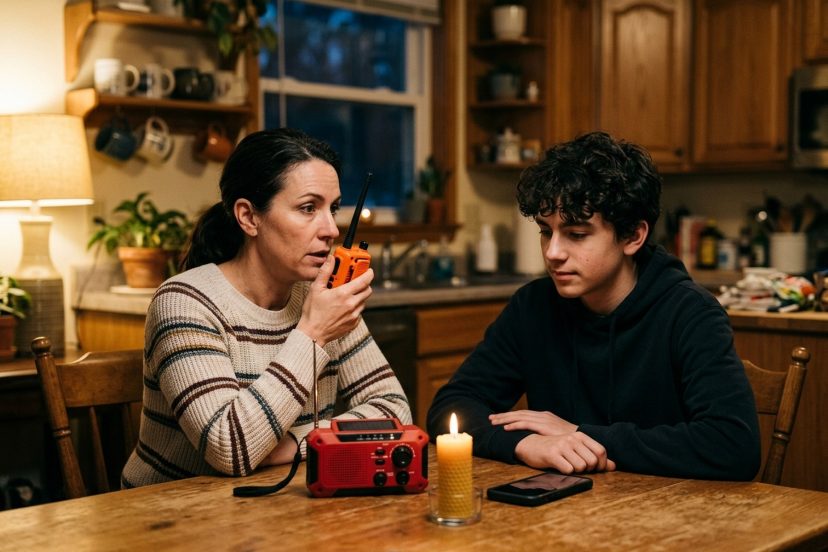
A two-way radio doesn’t touch the cell network at all, so it keeps working exactly when your phone stops. The two consumer options are FRS, which needs no license and no fee, and GMRS, which needs a one-time $35 FCC license (valid for 10 years, no exam, and it covers your whole immediate household under one license) in exchange for more usable range, roughly 1 to 2 miles handheld-to-handheld on flat ground, more with a repeater. For a family keeping in touch across a house, a yard, or a short walk to a meeting place, FRS channels on a basic set are usually enough; GMRS is worth the license if you want real range between a car and home, or between two households.
Keep a pair charged and labeled for each adult
The Motorola Talkabout T802 runs FRS channels out of the box with no license needed, is rechargeable, waterproof, and rated to about 35 miles in open, unobstructed conditions (expect much less in a neighborhood with buildings and trees; 1 to 2 miles is the realistic planning number). Keep one in each adult’s bag, not in a drawer.
How do you get information when the internet is down?
A two-way radio lets your household talk to each other. It does not tell you what’s actually happening, how long it will last, or whether it’s safe to go outside. For that you want a radio that receives NOAA weather and emergency broadcasts independent of the internet or cell towers, and that charges itself so a dead phone battery doesn’t become a dead information source too.
A hand-crank radio needs no outlet and no signal
The Midland ER310 pulls in NOAA weather alerts on battery, solar, or hand-crank power, and doubles as a phone charger and flashlight. It’s the single item that keeps working when both the power and the network are out at once.
How do you keep your phone usable when towers are overloaded?
Sometimes the network isn’t fully down, it’s just overloaded: everyone in the area is trying to call at once, the way lines jam after a storm or a major news event. Two habits help here, and neither needs new gear. First, text instead of calling; a text message needs far less network capacity than a voice call and can sit queued and deliver the moment there’s an opening. Second, wait a few minutes and try again rather than redialing immediately, which adds to the congestion. What does need new gear is making sure your phone has power to try at all, because a dead phone can’t do either.
A charged phone is still your fastest way back online
Keep a power bank charged in the same bag as your radio, not plugged into the wall where it’s useless in an outage. The Anker 737 holds enough charge for several full phone cycles and can also keep a laptop or tablet alive.
Canadian readers: Anker’s 20,000mAh 87W power bank is the equivalent pick on amazon.ca.
What if someone is away from home when it happens?
Two-way radios and NOAA radios both assume your household is within a mile or two of each other. If someone commutes, travels for work, or spends weekends outside cell range on a trail or a lake, that assumption breaks. A satellite communicator sends texts and an SOS signal using satellites instead of cell towers, which means it works from almost anywhere the sky is visible, with an active subscription plan required to send messages. It’s a bigger purchase than the other items here, so it earns its place only for households where someone is regularly out of range, not as a default for everyone.
For the person who’s regularly out of cell range
The Garmin inReach Mini 3 sends two-way text messages and an SOS alert from almost anywhere, through satellite coverage rather than cell towers. A subscription plan is required to send; check Garmin’s current plans before you buy.
If a satellite communicator is more than your household needs right now, a whistle and signal mirror are the cheapest reliable backup for getting attention over distance without any battery or subscription at all; three sharp blasts is the universal distress signal. Our full breakdown of carry gear for navigation and signaling is in why communication and navigation matter for survival and emergencies, which goes deeper on what to carry away from home than this household-focused guide does.
A no-battery backup, for under $15
The Eco-Fused whistle and signal mirror set needs no charging and clips to a bag or belt loop.
Calm + Courage: None of this requires predicting the next outage. It requires one conversation at the dinner table, one card in every wallet, and gear that’s already charged before the day you need it. Households that do this once rarely think about it again until the day it quietly saves them an hour of panic.
Shopping list: building your family communication kit
- Two-way radios, one per adult (FRS for most households; add a GMRS license if you need real range)
Motorola Talkabout T802: US | CA - A hand-crank or solar NOAA weather radio with phone-charging capability
Midland ER310: US | CA - A charged power bank kept with the radios, not plugged into a wall outlet
Anker power bank: US | CA - A satellite communicator, only if someone in the household is regularly out of cell range
Garmin inReach Mini 3: US | CA - A whistle and signal mirror as a zero-battery backup
Whistle and signal mirror: US | CA - A printed communication card for every household member (included in the free Outage Binder below)
Power stations, kits and more gear are in the full 72-hour gear hub.
FAQ
Do I need a license to use a walkie-talkie?
Not for FRS channels, which any basic two-way radio set can use with no license and no fee. GMRS channels need a one-time $35 FCC license good for 10 years, with no exam required, and it covers your immediate family members using the same licensed system.
How far do walkie-talkies actually reach?
Ignore the headline mileage on the box. Plan for 1 to 2 miles on open, flat ground for a handheld GMRS or FRS radio, and less through walls, hills, or dense neighborhoods. For a household staying in touch around one property or a short walk to a meeting place, that’s plenty.
Why text instead of calling during an outage?
A text message uses far less network capacity than a voice call, so it can often get through, or sit queued and deliver the moment there’s an opening, when a call attempt just fails outright.
Who should be our out-of-area contact?
Pick someone outside your city or state, ideally outside the region entirely, since a regional outage or disaster is less likely to affect their phone lines too. A relative or close friend works well. Make sure every household member, including kids old enough to use a phone, has that contact’s number memorized or written on their card.
Was the Rogers outage a cyberattack?
No. Rogers attributed it to an internal maintenance update that removed a routing filter, and Canada’s public safety agency said it was not a cyberattack. It’s included here because the household impact, no phone, no debit, no 911 on that network, looked identical to what a cyber incident would do, which is exactly the point: your plan should work regardless of the cause.
Do I need all five items to have a real plan?
No. The out-of-area contact and meeting places cost nothing and matter most. A radio pair and a hand-crank weather radio cover the two most common gaps for most households. The satellite communicator is worth it only if someone in your household is regularly out of cell range; most households can skip it.
Trusted resources and related guides
Trusted external resources
- Ready.gov: Make a Family Emergency Communication Plan
- FCC: General Mobile Radio Service (GMRS)
- Background on the 2022 Rogers Communications outage
Related SurvivalTactix guides
Next step
Get the free Household Outage Binder above, print the communication card, and pair it with our full household cyberattack plan for the rest of the outage week.